Work clothes: the jobs behind chore coats, jeans and carpenter trousers
Before they were finds, these garments were bought to be worn out. Each section names the job, the features the job demanded, and how much of that survives on today’s shelf. This is an independent reading of the catalog; Fatobuy does not run or review it.
Chore coats, work trousers and the pockets that held tools
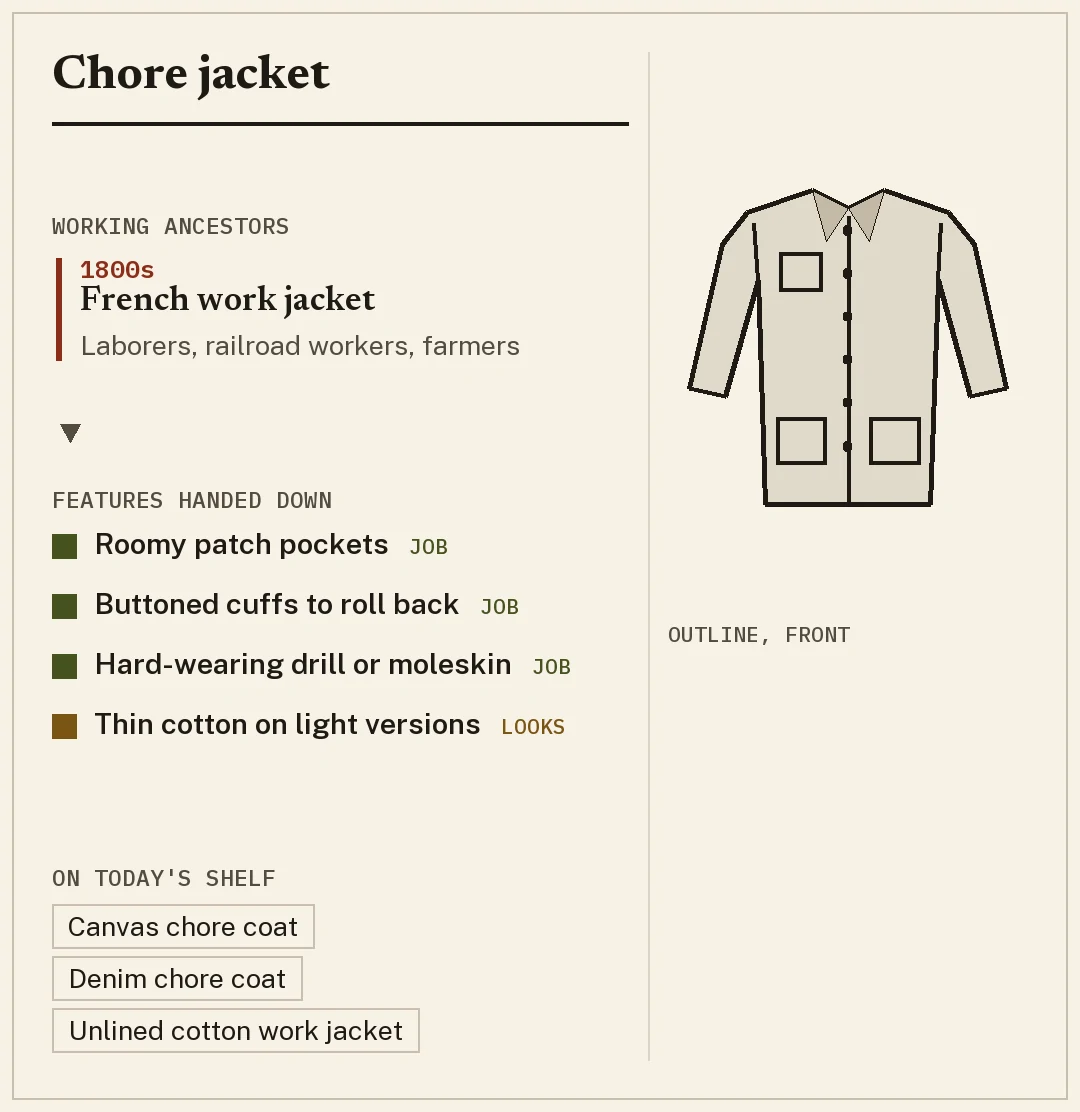
The chore coat is the plainest member of the family and one of the oldest. The encyclopedia entry on the chore jacket places its start in nineteenth-century France, cut for laborers, railroad workers and farmers in hard-wearing cloth such as denim, heavy cotton drill or moleskin. Two details came from the work itself: roomy patch pockets, at first for tools and tobacco tins, and buttoned cuffs that let a wearer roll the sleeves out of the way.
Put a catalog chore coat beside that description and most of the job survives. The patch pockets still take a phone, keys and a notebook without a bag. The buttoned cuff still opens so a sleeve can be pushed up for washing hands or carrying something messy. Neither feature asks anything special of the maker, which is partly why the shape has lasted.
What tends to change is the cloth. A heavy drill coat breaks in over years; a thin cotton version on a catalog shelf is a lighter jacket that borrows the outline. That is not a fault, just a different job. If the weight of the cloth matters to you, ask about it before you pay, because a front photo will not tell you.
Denim from the mine to the street
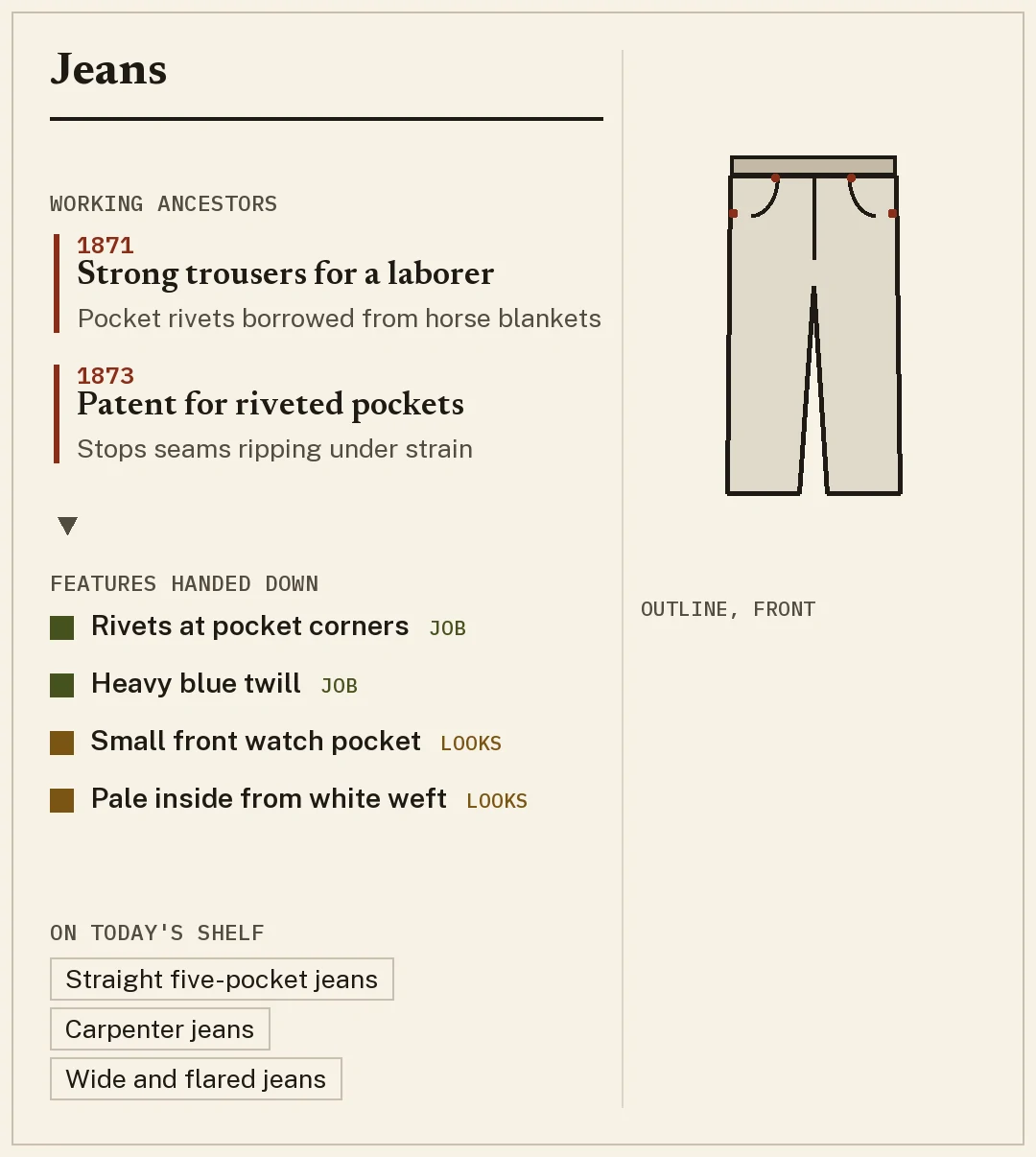
Jeans have the best paper trail of any garment on the catalog, because they were the subject of a patent and then a lawsuit. A deposition kept by the US National Archives tells the story in its maker’s own words: in January 1871 a woman asked him to make a strong pair of trousers for her husband, and he reached for the rivets he had been using to fix straps to horse blankets. The National Archives blog post quotes the result, patent 139,121 of 20 May 1873, for metal rivets at the edges of pocket openings.
The patent’s own text, readable in full online, says why: the rivet binds the cloth at each edge of the pocket so that frequent pressure or strain does not rip the seam. The trousers it protected were worn by factory workers, miners, farmers and cattlemen, according to the encyclopedia entry on jeans. In 2022 a cache of nineteenth-century denim trousers turned up in an abandoned Arizona mine, still dotted with candle wax, as Smithsonian Magazine reported.
The cloth itself is older than the trousers. Denim is a sturdy cotton twill, first made in Nîmes in France; the warp threads are dyed blue and the weft left white, which is why a pair of jeans is pale inside. Jeans moved from work to leisure after the Second World War, carried by films of the 1950s, and the workwear features came along unchanged.
Bib overalls and a garment built to take the dirt
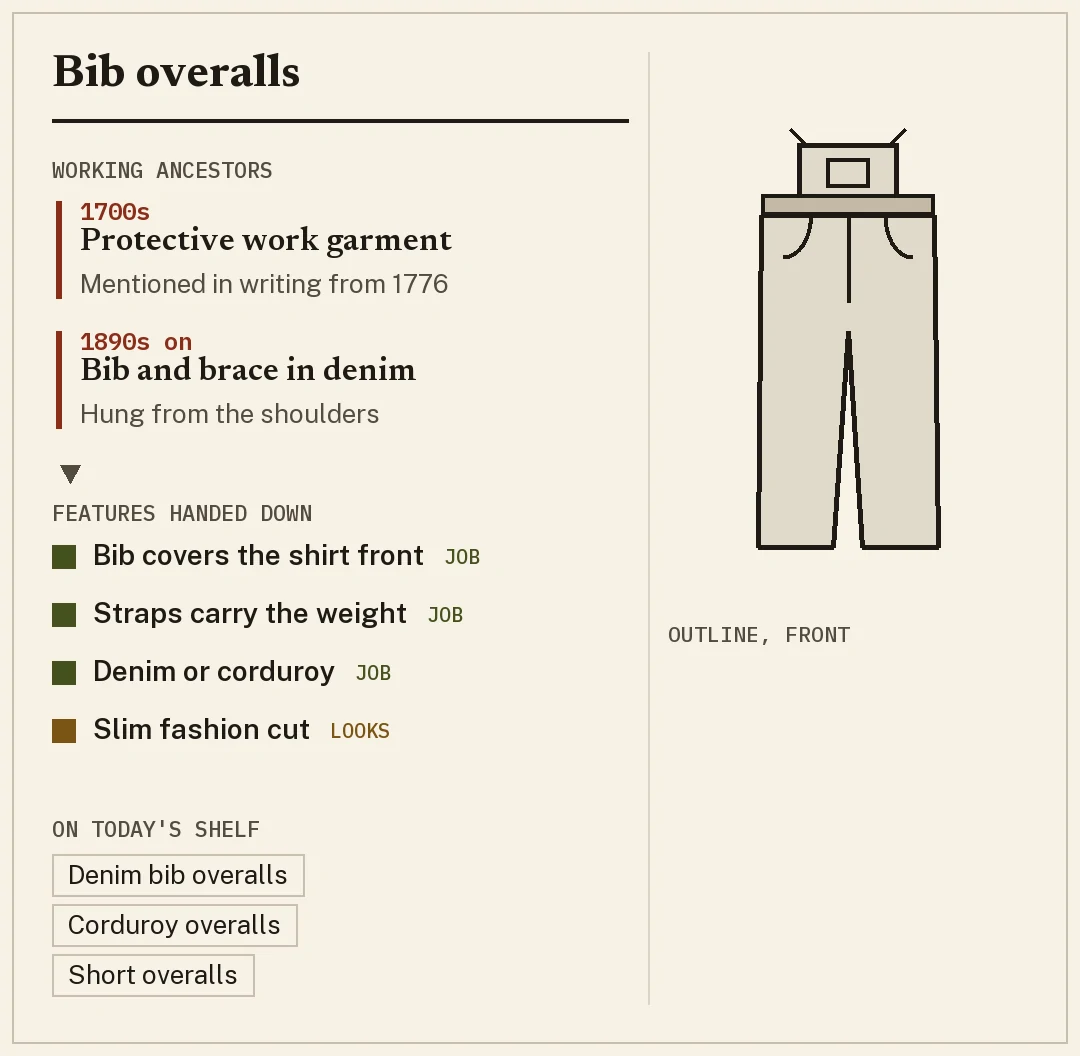
Overalls are protective clothing first and fashion a long way second. The encyclopedia entry on overalls finds written mentions of overalls as protective working garments as early as 1776, and says the bib-and-brace form went through several changes before reaching the shape we know, with denim as the usual cloth and corduroy, chino or leather as alternatives.
The job explains the design. A bib and straps carry the garment from the shoulders, so nothing depends on a belt while you bend, kneel or climb. The front of the body is covered, so whatever splashes lands on the overalls rather than the shirt underneath. Those reasons still hold for anyone painting a room or working in a garden, and they are the parts of a catalog pair worth checking.
On the catalog, overalls sit with jeans more often than with workwear, and many are cut slimmer than the old working pairs. A slim pair still has the bib and the straps; what it may lose is the room to kneel. That is a judgment about the cut, and only a photo of the garment laid flat, or worn, will show it.
Carpenter trousers and the loop most carpenters skip
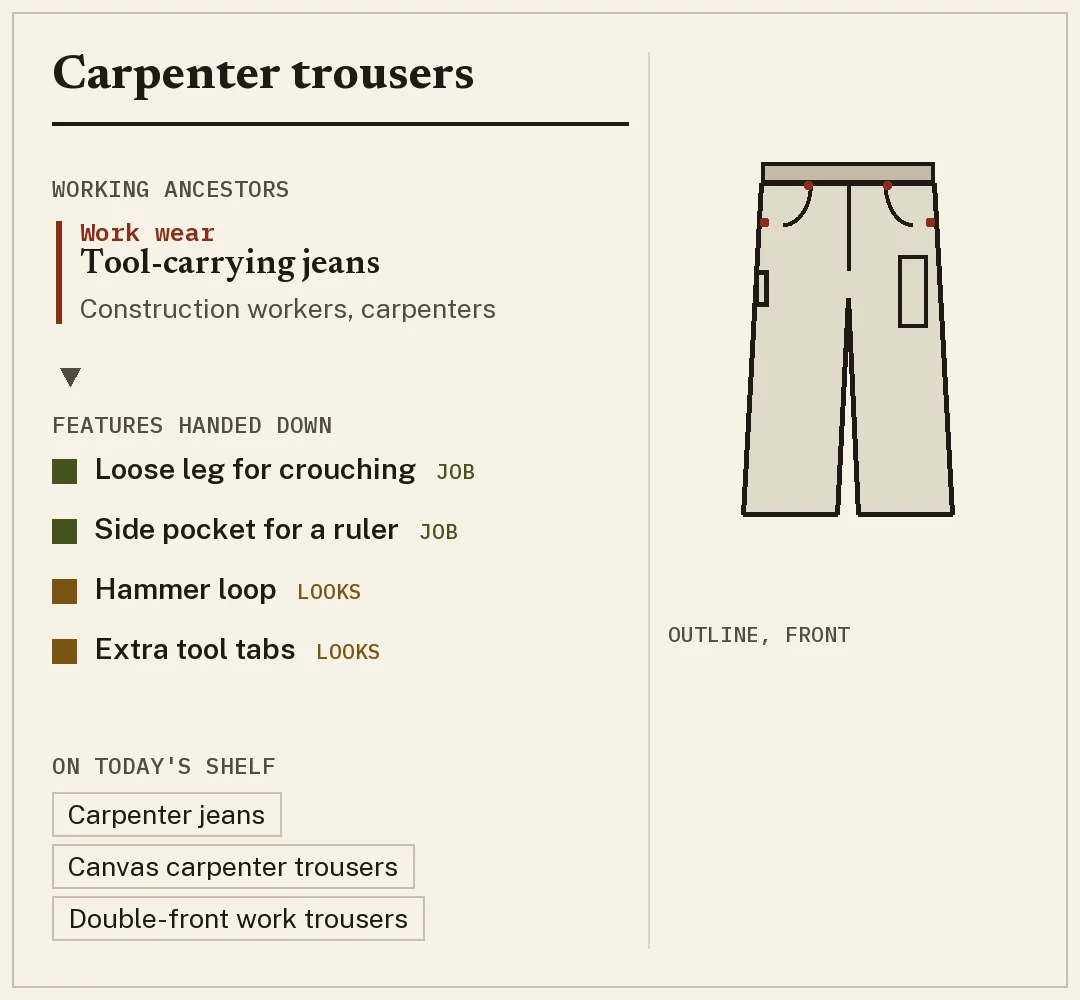
Carpenter trousers are jeans with extra places to put things: more pockets, loops that hang tools, and a loose leg so the loaded trousers still move. The encyclopedia entry on carpenter jeans says they took the name from the construction workers and carpenters who wore them to keep tools at hand while their hands stayed free.
The most famous detail is the hammer loop, usually on the left leg. The same entry is blunt about it: the loop was meant to let a carpenter carry a hammer without a tool belt, but most carpenters do not use it, because the hammer falls out or bangs around the leg. That makes the hammer loop one of the clearest cases of a feature kept for looks, and the entry flags that it needs better citations, so read it as a commonly reported point rather than a measured one.
The loose leg is another matter. Room in the thigh still lets you crouch without strain, and a carpenter’s side pocket still fits a folding ruler or a phone. On a work trousers shelf those two are the parts that still work; the loop is decoration with a story.
The donkey jacket and the fluorescent rail jacket
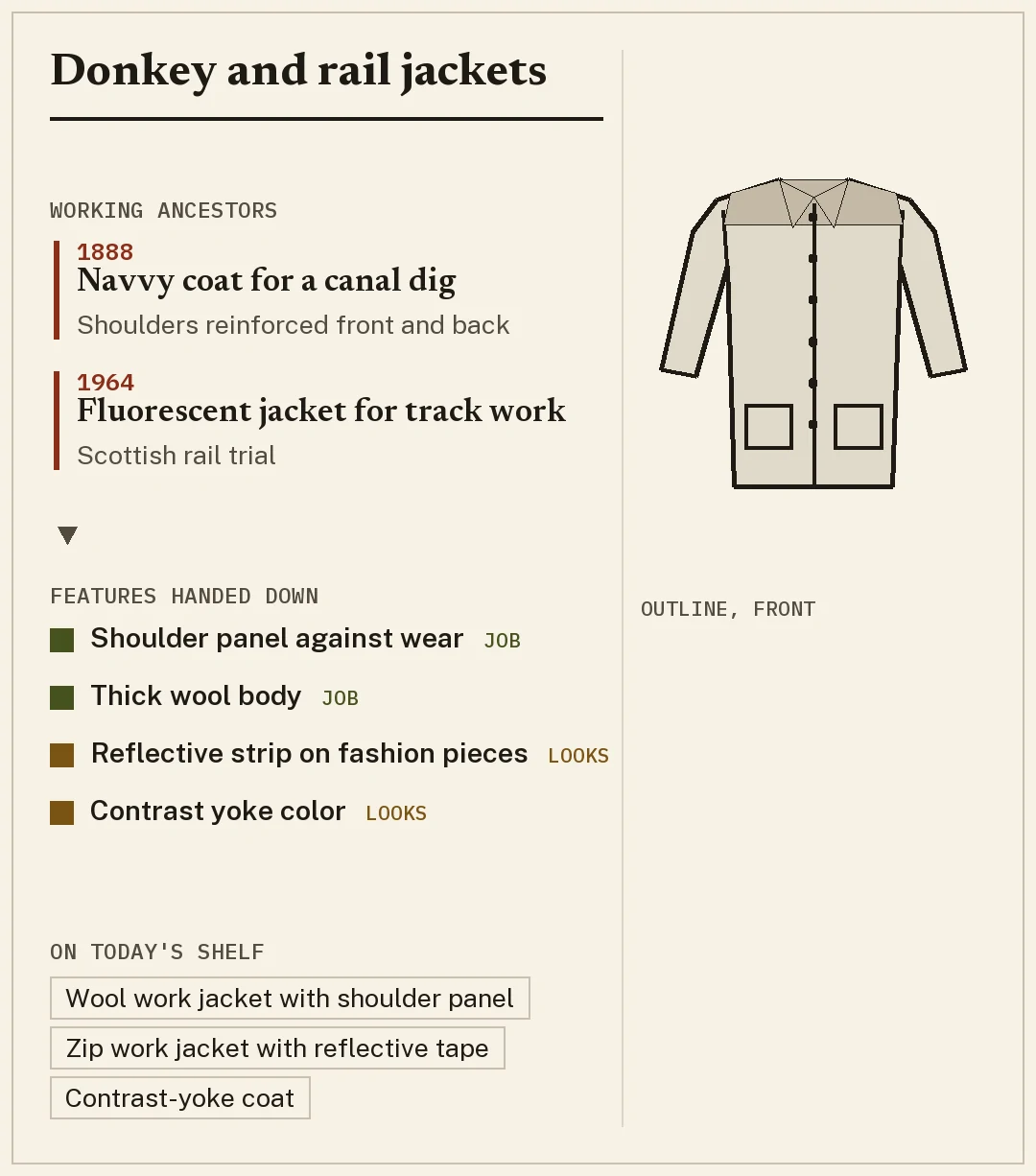
Two British work jackets show how a feature can change jobs. The donkey jacket, says the encyclopedia entry on the donkey jacket, was developed in 1888 by a draper in Staffordshire as a hard-wearing coat for the navvies digging the Manchester Ship Canal; some of the navvies worked donkey engines, steam-powered winches, which is where the coat’s name comes from. Its signature is the panel across the shoulders, front and back, in leather or PVC, there to reinforce the cloth and keep off the rain where loads were carried.
High-visibility clothing came much later. According to the encyclopedia entry on high-visibility clothing, experimental use began in 1964 on the Scottish Region of British Railways, where track workers were issued fluorescent orange jackets nicknamed fire-flies. Today it is personal protective equipment for road, rail and airport work.
On the catalog you will meet both as looks. A shoulder yoke in contrast fabric borrows the donkey jacket’s outline and still helps where a bag strap rubs. A reflective strip on a fashion jacket borrows the rail jacket’s look, but it is not certified safety wear, and no listing photo can prove that it is.
The work tee and the jean jacket
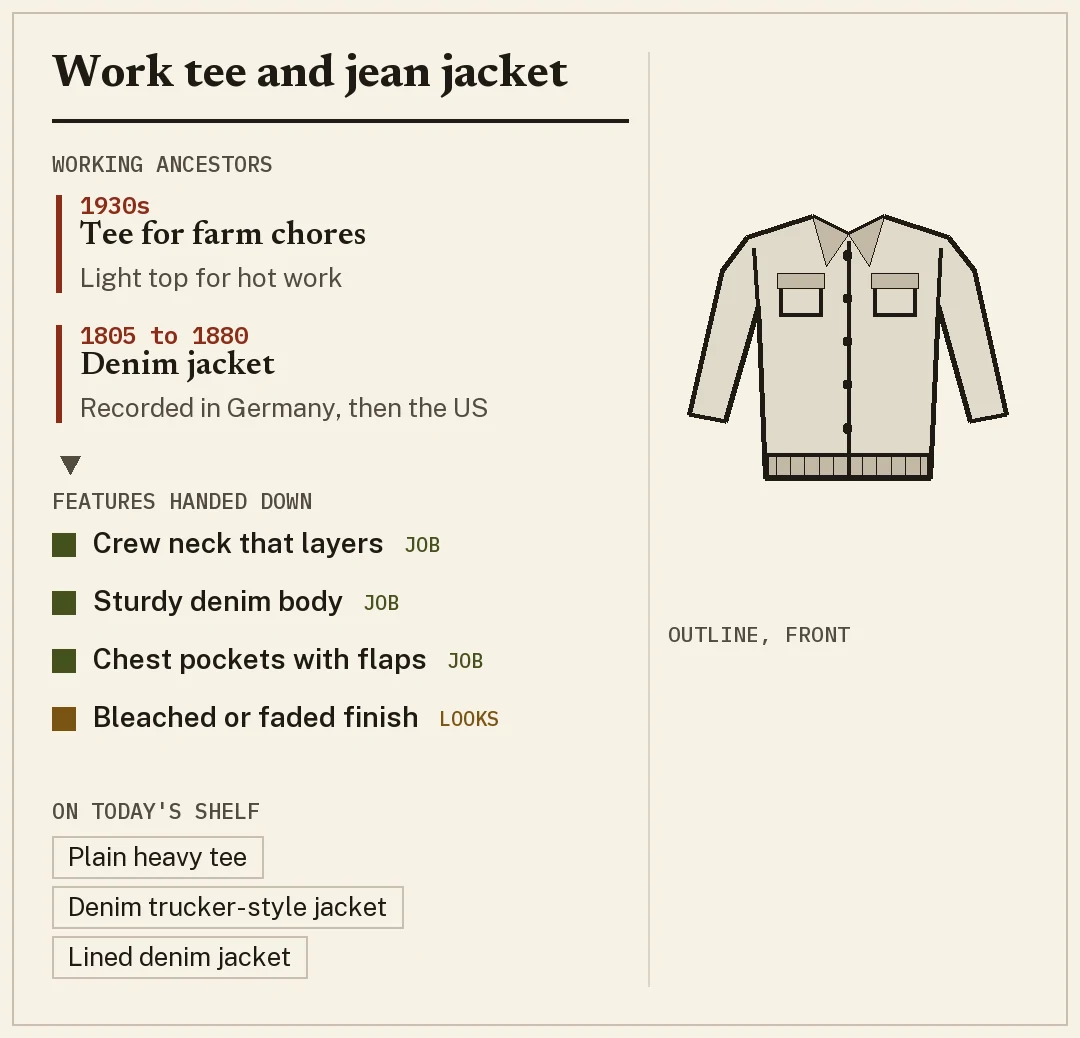
Two garments joined the work family almost by accident. The tee, a navy undershirt in 1913, had become by the Great Depression the default garment for farm and ranch chores whenever modesty called for a top and the heat called for something light; the encyclopedia entry on the T-shirt describes that shift. Nothing about a plain tee needed redesigning for work. It was already light, cheap and easy to wash.
The jean jacket is a denim jacket built like workwear. The encyclopedia entry on the jean jacket notes that the earliest recorded denim jacket sits in the collection of a historical commission in the German Rhineland and dates to 1805 or 1810, and that the first American example on record dates from about 1880. Denim jackets moved from blue-collar wear to fashion over the following century.
For both, the working features are the plain ones. A crew neck that layers, short sleeves that stay out of the way, a jacket cloth that takes rough handling. Look for those on the tee shelf and the light jacket shelf; the rest is styling.
Checking a work garment in the warehouse photos
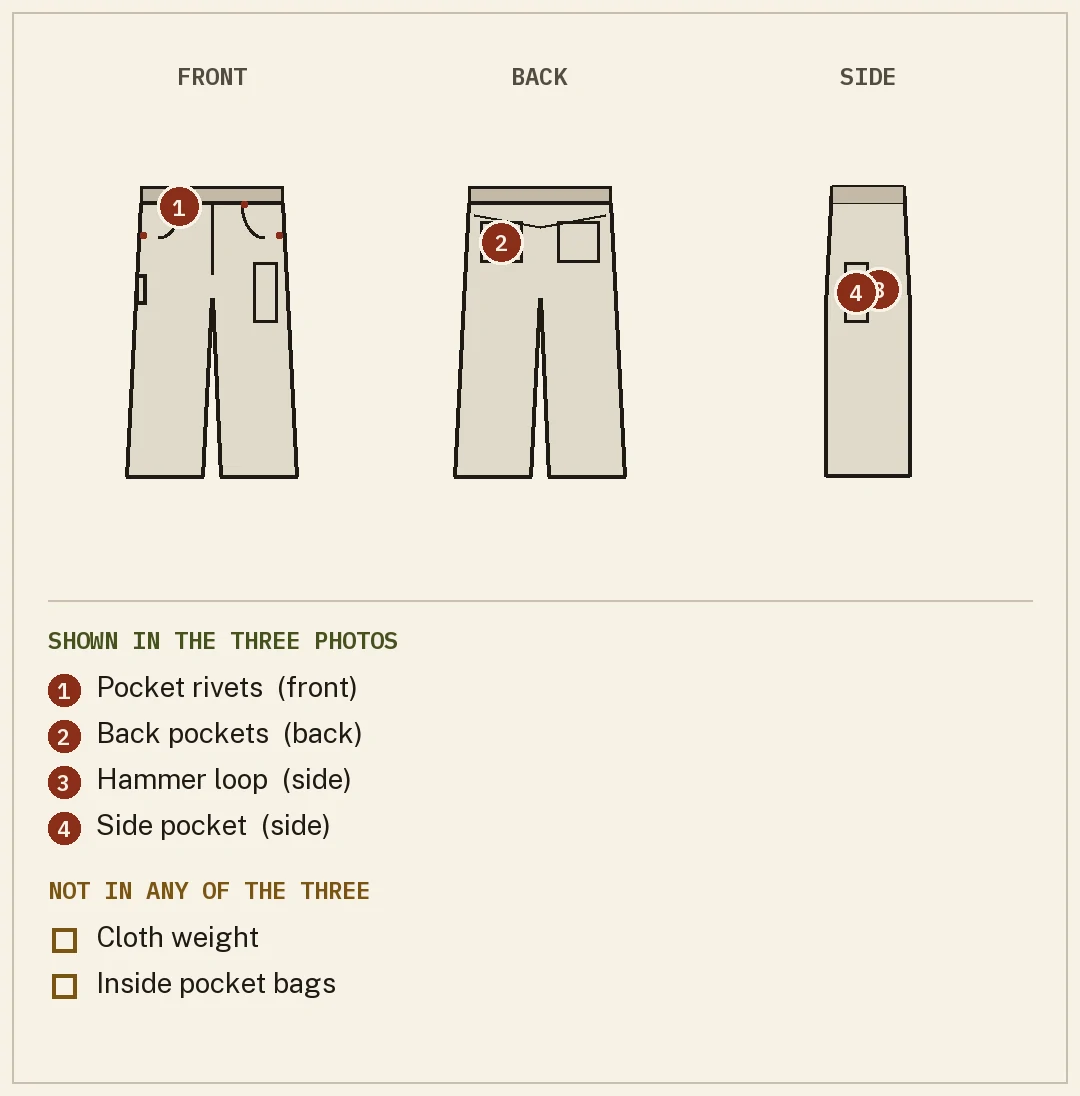
Work clothes keep most of their inherited features on the outside, which makes them the easiest family to check from photos. On jeans, the front photo usually shows the pocket corners, so you can see whether rivets are there at both edges. On a chore coat, the front shows the patch pockets and, with luck, the cuff buttons. On carpenter trousers, the loop and the side pocket sit on one leg, so they appear only if the side photo is taken from that side.
Fatobuy’s help center says the regular photos are generally three: a shot of the front, another of the back, and a third that catches a side or the logo. For a work garment, the front and back carry most of the evidence; the side photo is the one that may miss the carpenter details. If the cloth weight matters, ask for a close photo of the fabric next to something for scale, or simply ask whether the piece feels heavy or light.
The full method, garment by garment, is on the reading a find page. The habit to build is simple: decide which inherited feature you are buying for, then look for it before the parcel is packed.