
Reading a find against the job its ancestor did
Knowing where a garment comes from is only useful if you can check for it. This page turns the family trees into a short routine for the listing and the warehouse photos. Independent reading; Fatobuy does not run or review this site.
Today’s find beside the job its ancestor did
Reading a find this way takes four moves. First, name the ancestor: is this jacket a flying jacket, a field jacket, a warm-up top or a work coat? The family pages and the viewer on the home page help. Second, list the features that job demanded, using the ancestor’s card. Third, look for those features on the seller’s listing. Fourth, after Fatobuy receives the piece, look for them again in the warehouse photos.
This is how to judge a piece without judging its label. It tells you nothing about who made the garment and everything about whether the details you care about are there. It also gives you a short, specific question to ask if something is missing, which is far more useful than asking whether a garment is good.
Below, each move gets its own section and examples, then covers the warehouse photos in detail: what the standard set usually catches, what it misses, and how to ask for the one photo that settles the question.
What a listing usually shows of an inheritance
Seller listings are made to sell the outline, so they show the outside of a garment from its best side. In practice that means inherited features on the front are well covered and features inside or on one side often are not.
How to judge a seller here is simple: by how much of the garment they show. A listing that includes the inside of a jacket, the corners of the pockets, the cuff closures and the hem is usually from a seller who expects buyers to check. A listing built from a single styled image tells you less, and a listing that names a label in its title is not something this site covers.
Whatever the listing shows, write down the two or three inherited features you are buying for before you order. That list is what you will check later, and it keeps a good photo of the wrong detail from distracting you.
Where the three standard photos fall short
When a piece reaches Fatobuy’s warehouse, the regular check comes with photos at no extra cost. The help center describes generally three, aimed at the garment’s face, its back, and a side or its logo; the home page says three free photos. Read it as usually three basic photos, not a fixed promise.
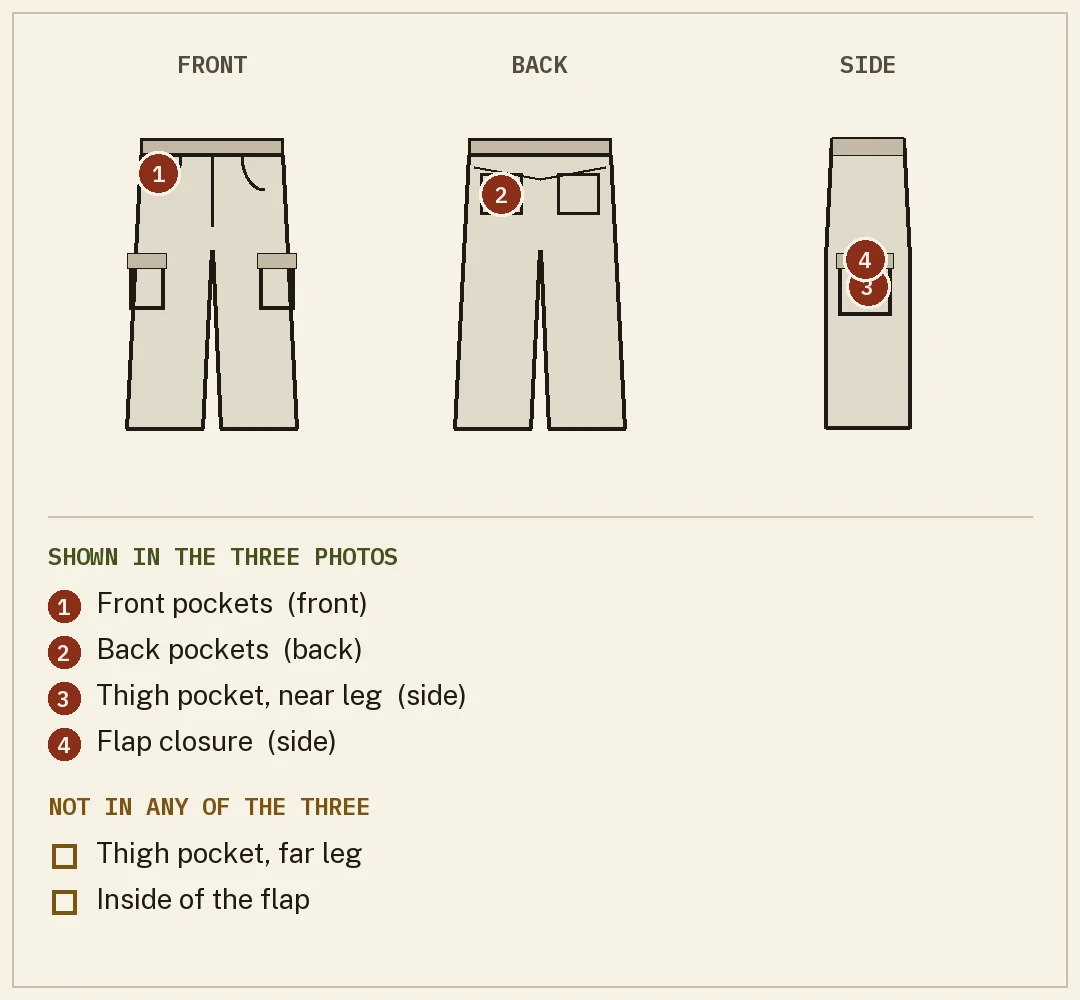
Those angles are chosen to confirm that the right item arrived undamaged. For an inherited feature, they are hit and miss. The front photo is good for zips, chest pockets, pouch pockets and rivets. The back photo catches yokes, back pockets and the hood’s outline. The side photo is a lottery: it shows a cargo pocket, an ankle zip or a hammer loop only if it is taken from that side.
And some ancestral features never appear in any of the three: the orange lining of a flight jacket, the hood zipped into a field jacket’s collar, the liner of a parka, the drawcord channel of a hood, the pocket on the far leg. If the reason you chose the garment is in that list, plan on a detail photo.
Asking for the one detail that matters
Fatobuy sells extra detail photos, one detail to each photo, which you order for an item once it is in the warehouse.
Because each photo covers one detail, the request should name one inherited feature in plain words. For a field jacket: “the collar with its zip open, showing whether a hood is inside.” For a flight jacket: “the jacket open, showing the lining.” For track pants: “the bottom of one leg from the side, showing the ankle zip.” For cargo trousers: “the second thigh pocket with its flap lifted.”
One well-chosen detail photo usually answers more than a full extra set. If the answer is no, you have learned it while the piece is still in Fatobuy’s warehouse, which is the cheapest place to change your mind.
Warehouse photos, checked one feature at a time
When the warehouse photos arrive, read them against the list you made before ordering. That is the whole of how to check QC photos for an inherited feature: one feature at a time, yes or no, with the ancestor’s reason in mind.
On jeans, count the rivets at the front pocket corners; the patent put one at each edge. On a hoodie, check that the drawcord comes out of the hood on both sides. On a bomber, look at the cuffs and waistband for knit bands rather than plain hems. On cargo trousers, check that the thigh pocket has a flap and something to close it with. On a trench coat, look for the storm flap on the chest and the straps at the cuffs.
What the photos cannot tell you is how a feature feels in use: whether a zip runs smoothly, whether a knit band grips. Those are not things this site can judge either. Keep the questions to what a photo can show, and you will rarely be surprised by what arrives.
Before you order: words that promise more than photos
Some listing words are worth a second look before you pay. Military, army, workwear and utility describe a style. Spec codes such as MA-1 or M-65 describe a cut. None of them guarantees that the working features of the ancestor are present, and none of them is evidence that a garment was ever issued to anyone.
Watch out for claims that are really about a feature: reversible, packable, with hidden hood, waterproof, reinforced. Each one can be shown in a photo, so ask to see it if the listing does not. Treat claims about weather protection with particular care; a windbreaker is built for wind and light rain, not storms.
And when a listing leans on a label rather than on the garment, this site is the wrong guide. We read clothes by type and history and leave labels out entirely.
Picking a catalog and an agent with this in mind
Choosing a spreadsheet site for this kind of reading comes down to what it tells you about each shelf. A catalog that only lists product names leaves the history to you. One that dates its claims, links its sources and says who keeps it is easier to trust, whatever its subject. Apply that test to this site too; the sources and the date of our last check are on the about page.
The agent matters at the photo stage. What you want from an agent for this kind of buying is a clear standard photo set, a way to order a single detail photo, and enough free storage time to wait for an answer. Fatobuy offers all three, on the terms set out on our Fatobuy page. Other agents offer similar services on different terms.
Whichever you use, the reading itself does not change. Name the ancestor, list the job, look for the features, and ask for the one photo that matters.