Sports fields: the practice jerseys, warm-ups and caps behind today’s shelves
Athletes needed clothes for the minutes before and after the game: warm, loose, quick to take off. Most of the sports family still carries those answers. Independent reading of the catalog, not run or reviewed by Fatobuy.
Hooded sweatshirts and the cold rooms they were made for
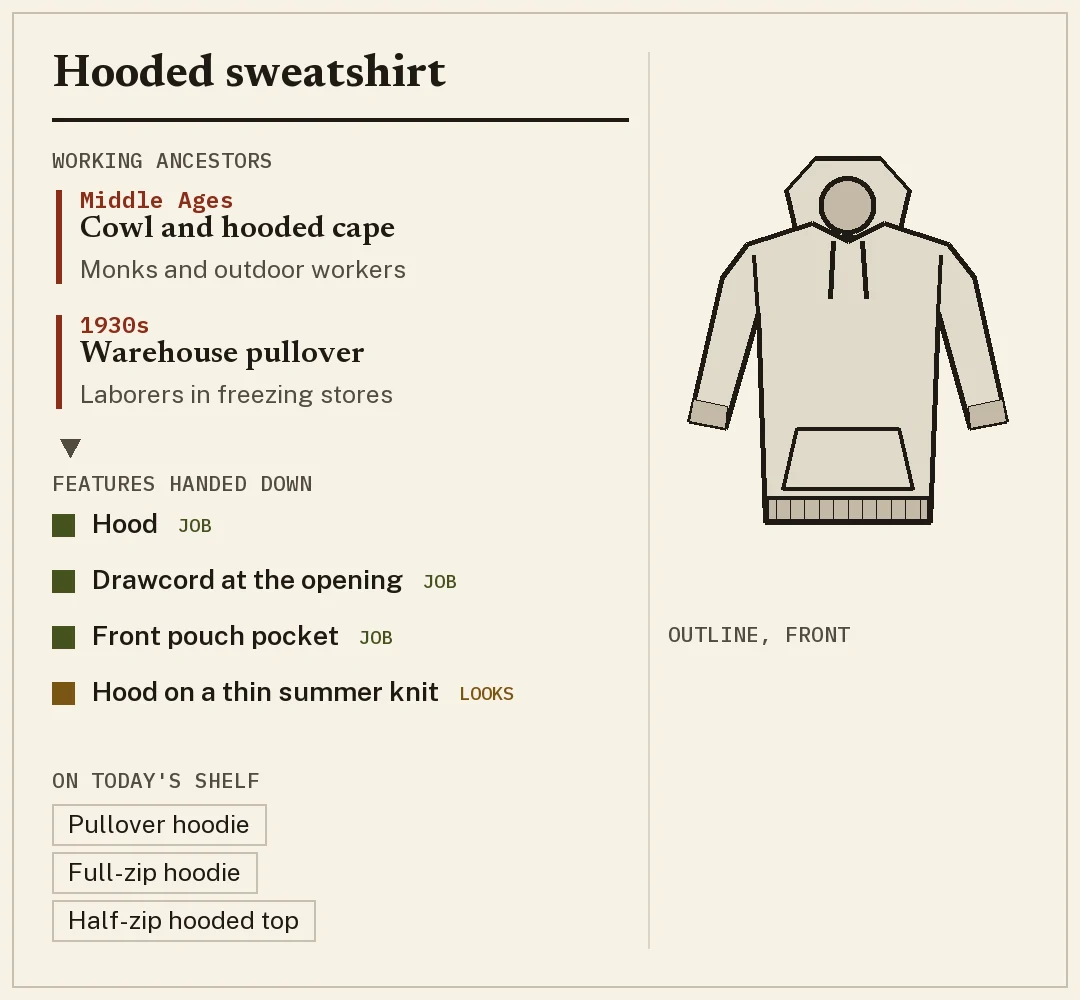
The hood is far older than the sweatshirt. The encyclopedia entry on the hoodie traces it to medieval Europe, where monks wore a hood called a cowl attached to the robe, and outdoor workers commonly wore a hooded cape. The hooded sweatshirt as a garment is usually dated to the 1930s, when, by the usual account, a knitwear maker in upstate New York sold it to laborers working in freezing warehouses.
The same entry describes the features most hoodies still share: a drawstring to adjust the hood opening, and on pullovers a single large front pocket, the kangaroo pocket or muff, while zip versions put a pocket each side of the zip. It gives the reasons people wear one in plain terms: looks, or protection against cold, wind and rain.
Athletic culture took the hoodie up later, and the 1970s made it street wear. Read on the hoodie shelf, the hood, the drawcord and the pouch still do the cold-room job. The hood on a thin summer hoodie is the honest exception: it is there for the outline.
The practice jersey that became the sweatshirt
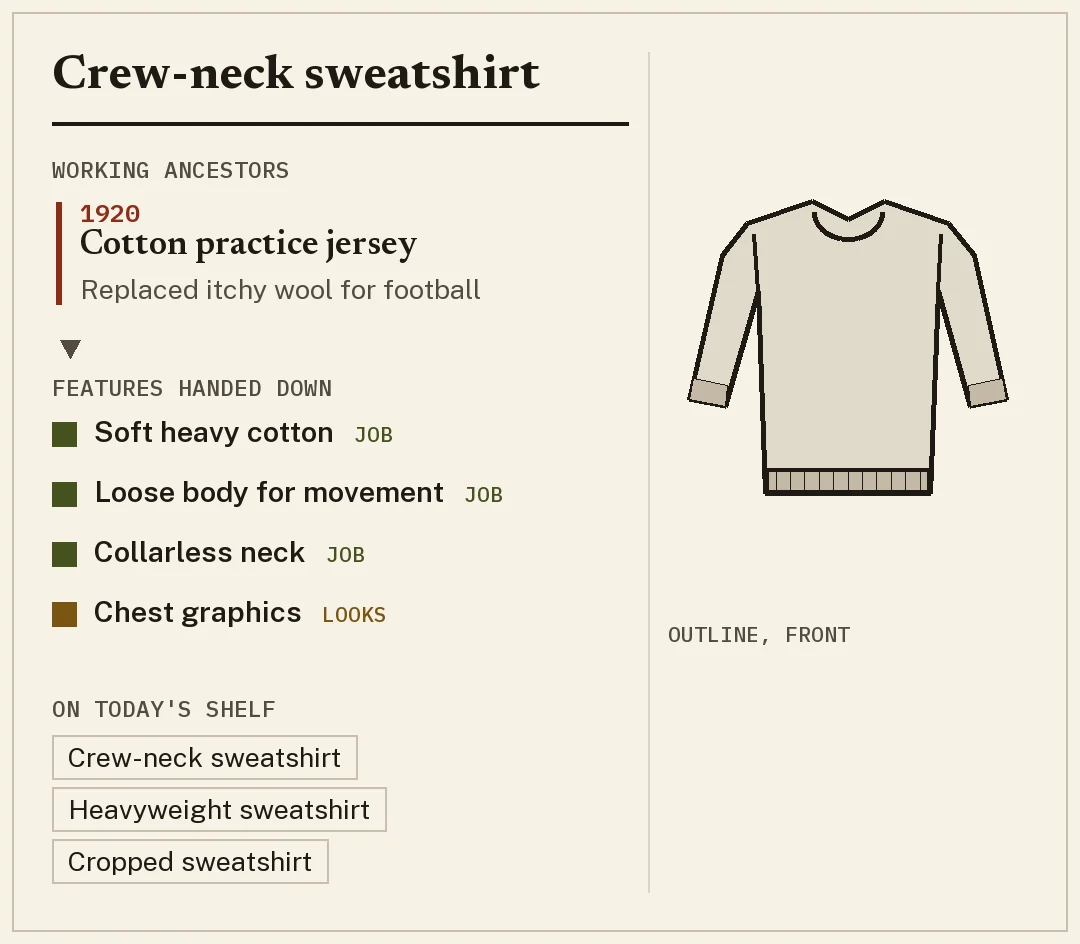
The crew-neck sweatshirt began on a practice field. According to the encyclopedia entry on the sweatshirt, in 1920 a college quarterback in Alabama, tired of the chafing and itching of wool football uniforms, worked with his father’s knitting company on something better. They made a thick cotton practice jersey, adapted from a top first knitted for women, loose and collarless.
Everything that defines a sweatshirt follows from that brief. Cotton instead of wool for skin that sweats. A loose body that does not restrict a throwing arm. No collar to rub the neck. The entry notes that a sweatshirt may or may not have a hood, and that the hooded version is now usually called a hoodie.
On the knitwear and sweatshirt shelf, those working features are still the point: soft heavy knit, a roomy cut, a plain crew neck. Graphics across the chest are decoration; they do nothing for training.
Track tops and the athletes’ warm-up
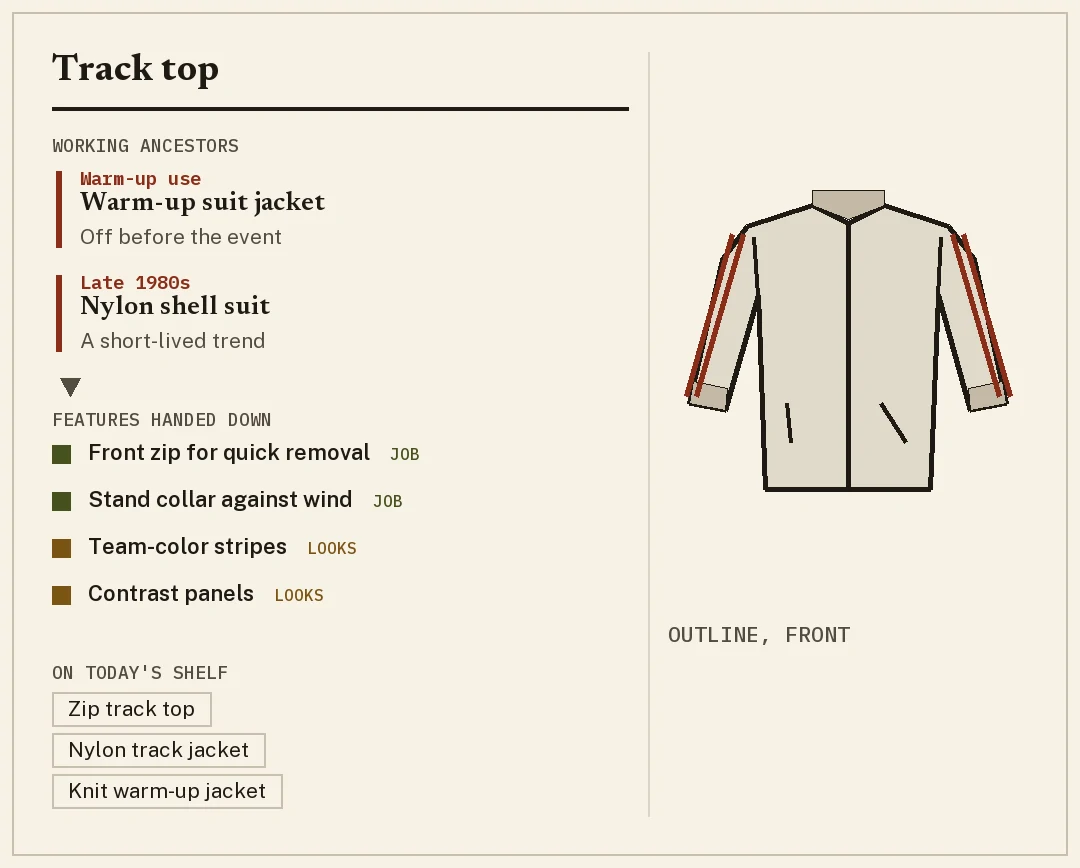
A track top is half of a warm-up suit. The encyclopedia entry on the tracksuit says tracksuits were designed to keep the body warm during and after athletic activity, worn over competition clothing such as a running vest or a swimsuit and taken off before the event. That is why they are also called warm-up suits, and why the jacket opens with a front zip: it has to come off fast.
The same entry explains the colors. Sports teams wear warm-ups in fabric matching their official team, school or country colors, which is the origin of the panels and stripes that make a track top recognizable. Nylon shell suits replaced many tracksuits in the late 1980s, a trend the entry says lasted only a few years.
Read on the catalog, the zip still does its job, and so does a collar that stands up against wind. The stripes are the clearest kept-for-looks feature in the sports family: on a catalog track top they say sport, but they no longer say which team.
Sweatpants, track pants and the zip at the ankle
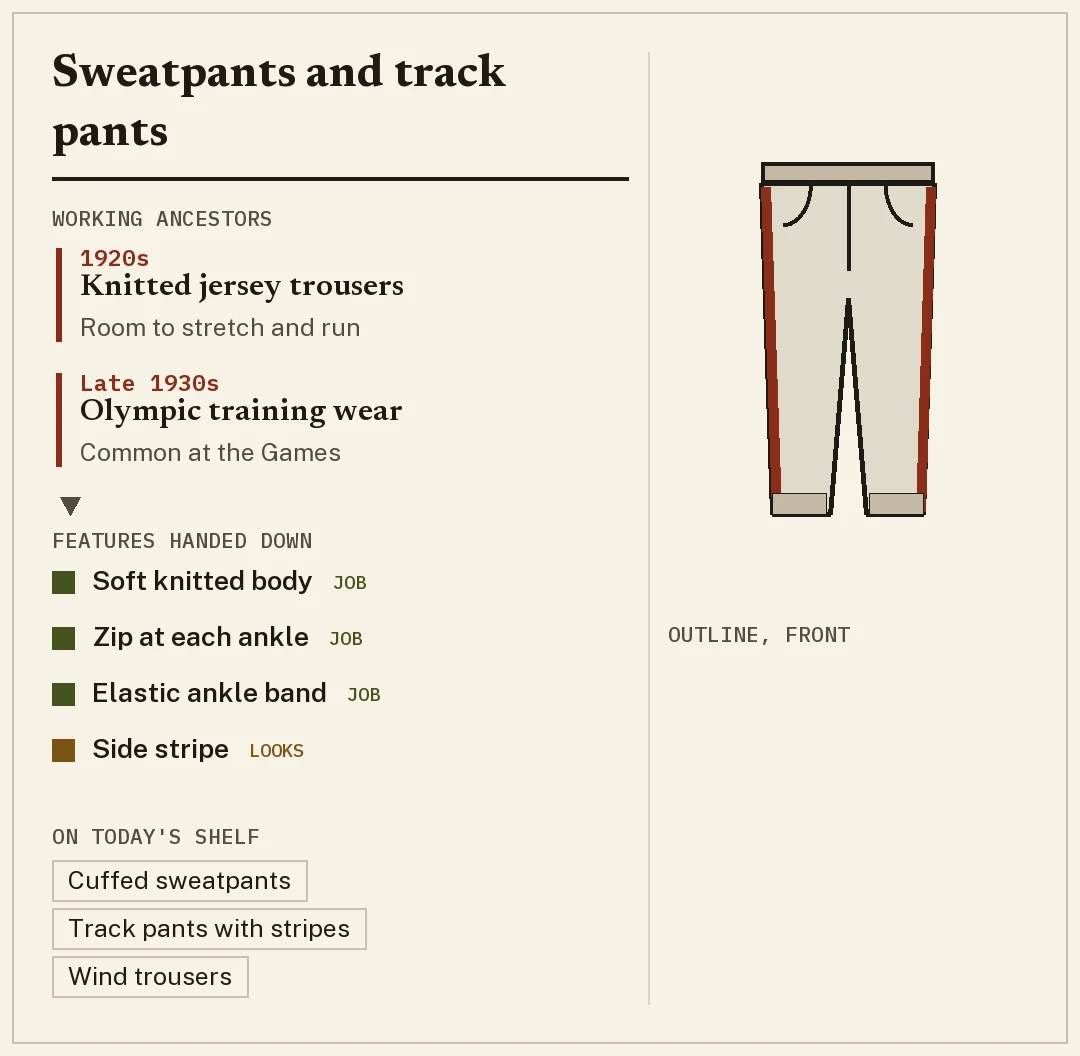
Sweatpants started as training gear. The encyclopedia entry on sweatpants dates the first pair to the 1920s in France: simple knitted gray jersey trousers that let athletes stretch and run comfortably. By the late 1930s they were common at the Olympic Games. The tracksuit put them together with a matching top, and the bottoms kept the name sweatpants.
The variations each answer a sporting problem. Wind trousers are lighter, shield the wearer from cold wind rather than insulate, and often have a zip at each ankle so athletes can open the leg and pull the trousers off over their shoes. Tearaway trousers take the same idea further. The entry also notes that fashion versions usually lack the elastic band at the ankle that training pairs have.
On the track pants shelf, soft knit, an elastic ankle and ankle zips are inherited features that still work. The side stripe is the look. Ankle zips are easy to miss in photos because they sit low on one side of each leg; look for them in the side shot, and ask if it is cropped.
Letter jackets and the letter you had to earn
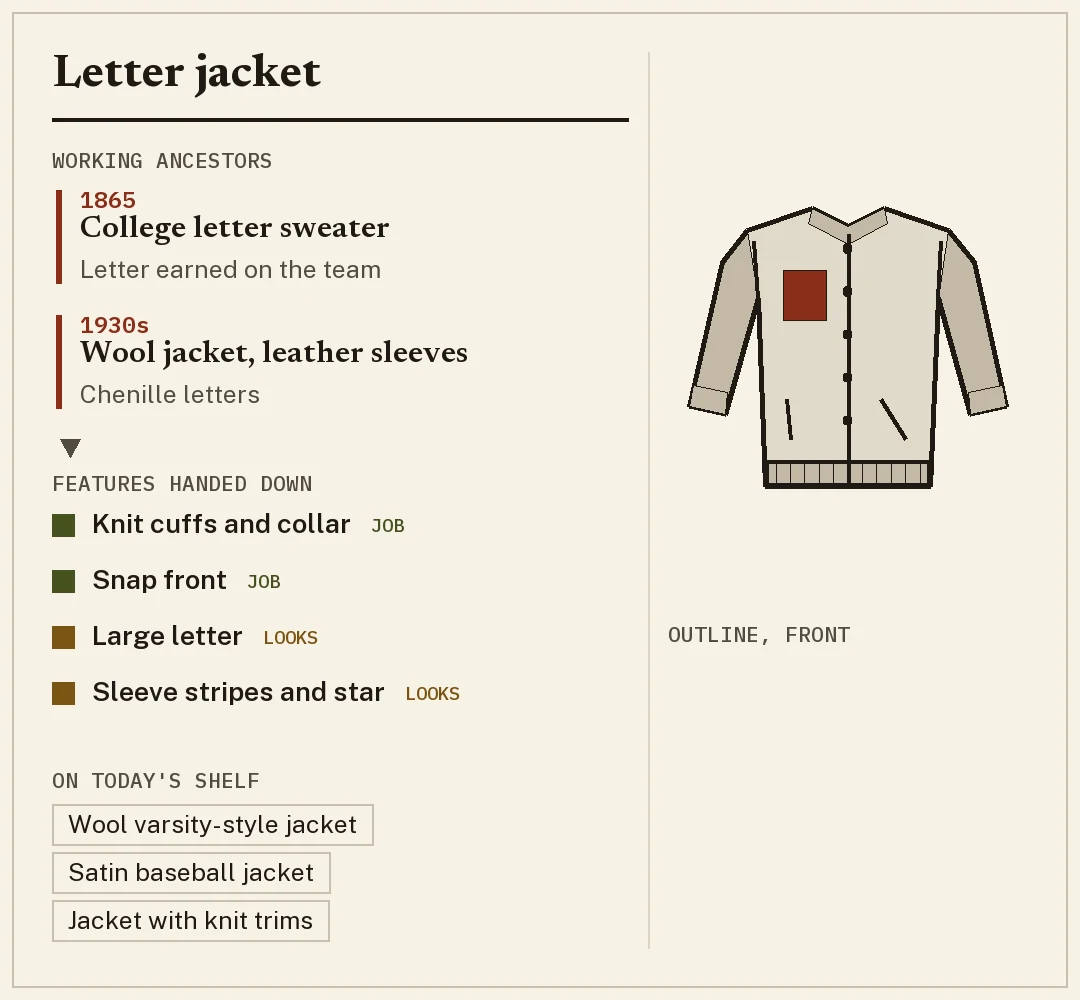
The letter jacket records an achievement. The encyclopedia entry on letter jackets traces it to letter sweaters first introduced by the Harvard University baseball team in 1865. The letter was large and centered; stripes on one sleeve showed how many letters the wearer had won, and a star marked the team captain. By the 1930s the familiar form had arrived: a wool jacket with leather sleeves in a different color and chenille lettering.
Almost everything on a letter jacket was a message rather than a tool. The letter said you made the team; the stripes counted seasons; the star named the captain. Those meanings only work inside a school, among people who know what was earned.
A catalog letter jacket keeps the outline: wool body, contrast sleeves, knit cuffs and collar, snaps down the front. The knit trims and snaps still do ordinary jacket work. The letters and patches are kept for looks, and they are also where branded marks tend to hide, so this site leaves them out of its notes entirely.
Ball caps and the peak against the sun
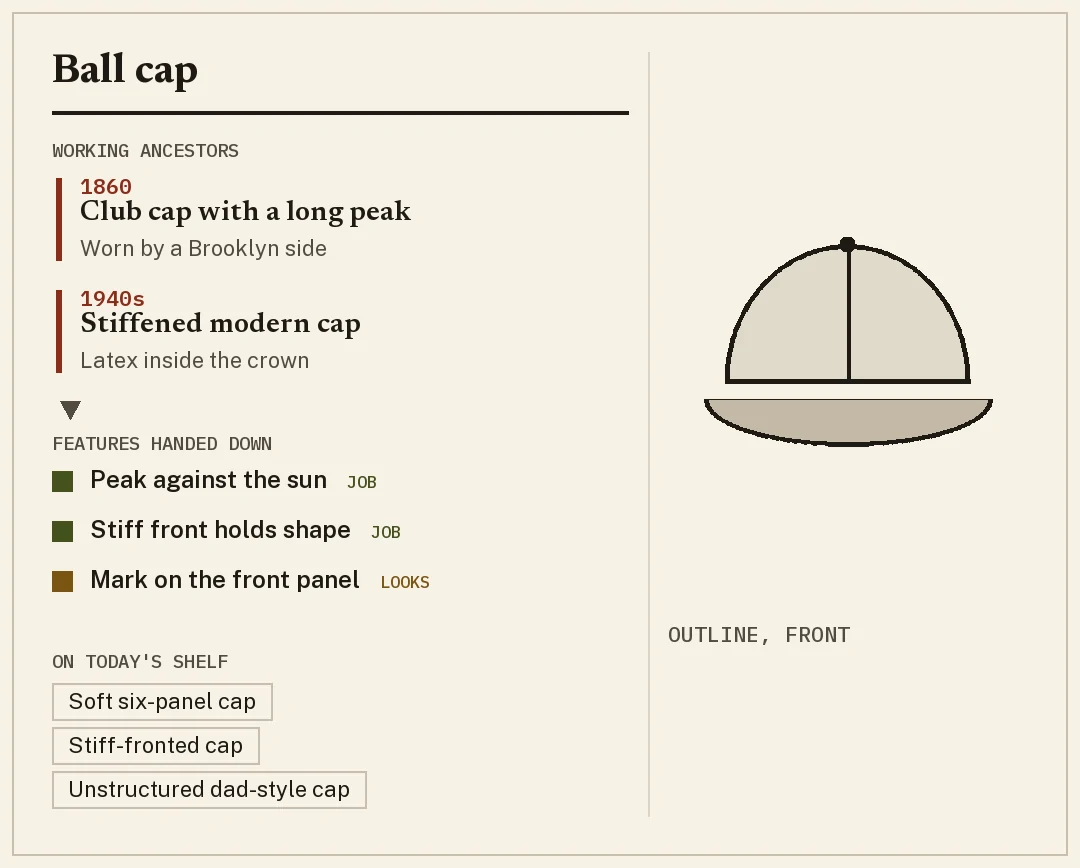
The cap on the hat shelf has a long sporting past. The encyclopedia entry on the baseball cap says a Brooklyn club wore the precursor of the rounded modern cap in 1860, with a long peak and a button on top, and that by 1900 the Brooklyn style had become popular. In the 1940s latex rubber became the stiffening inside the cap, and the modern baseball cap was born.
The peak, or bill, was designed to protect a player’s eyes from the sun. The front of the cap historically carried a design, usually a team’s, and later the names of companies when caps became advertising.
Both halves of that history show on a cap shelf. The peak still shades your eyes, and a stiff front still holds its shape. The front panel is now a billboard for whatever the maker chooses; a plain front is the version this site would point you to, since the mark there was always the team’s business, not the wearer’s.
Checking a sports find in the warehouse photos
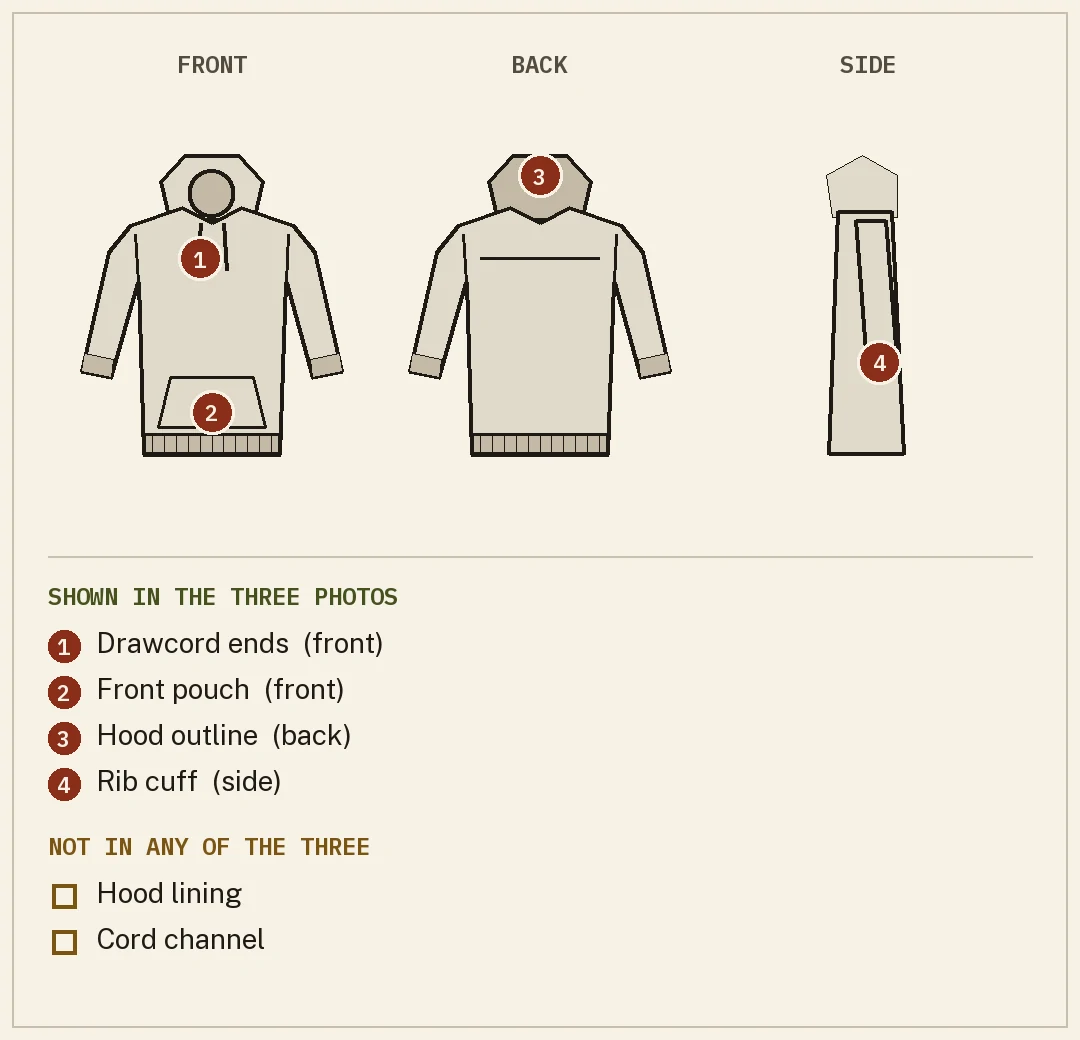
Sports garments hide their working features in predictable places. On a hoodie, the drawcord channel and the inside of the hood fold behind the neck; a front photo shows the cord ends and the pouch, but not whether the hood is lined. On track pants, the ankle zip sits on the outside of one leg near the hem, so only a side photo taken low enough will show it. On a track top, the stand collar is easy to see; the inside zip guard is not.
Fatobuy’s regular photos are generally three, a front shot and a back shot plus one more of a side or the logo. For sports clothes the back photo is often the least useful, because most of the inherited details sit at the front or the hem. If one feature is the reason for the purchase, a paid detail photo of that feature is the cheapest way to settle it before shipping.
And for letter jackets and caps, the front marks are exactly where this site stops. We read garments by type and history, never by label.