Outdoors: parkas, down jackets and windbreakers and the cold they were made for
The outdoor family was shaped by weather: Arctic hunting, high mountains, long watches on deck. Its working features are mostly about trapping air and shutting out wind. Independent reading; Fatobuy does not run or review this site.
Parkas and anoraks from the Arctic
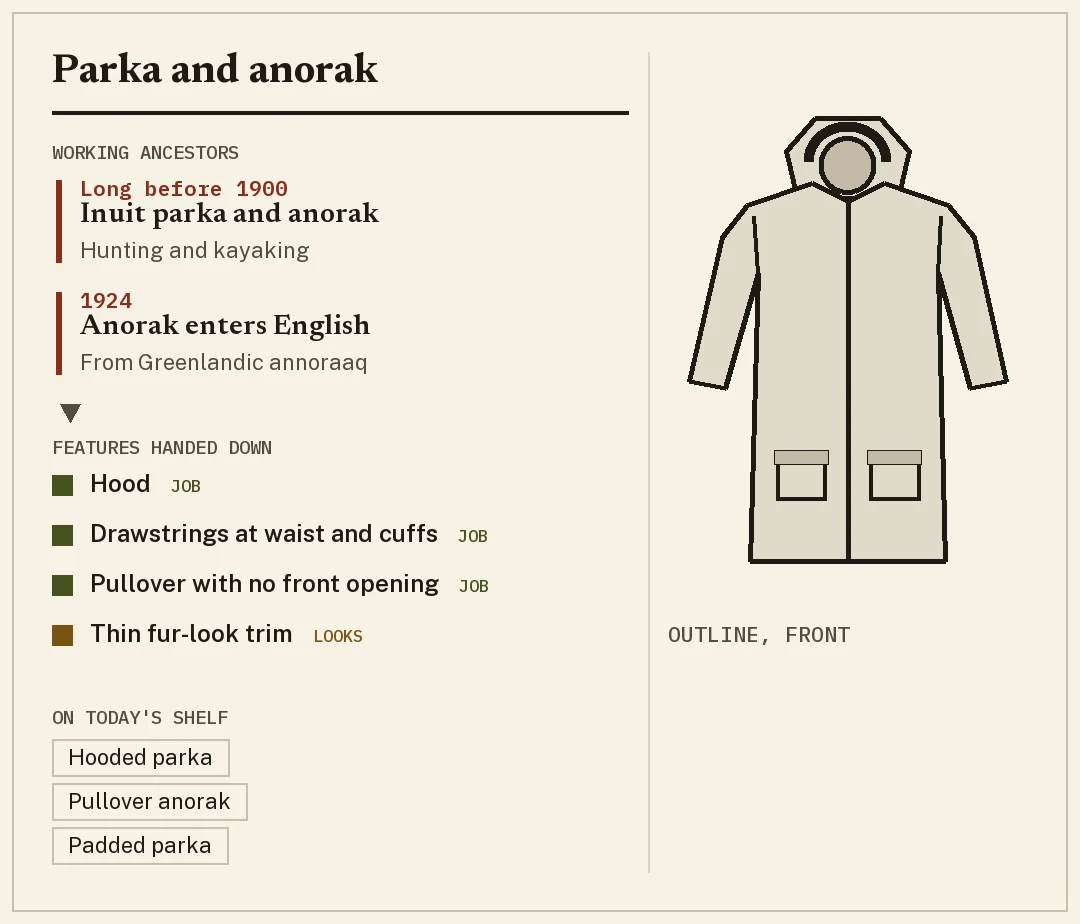
The hooded cold-weather coat comes from the Arctic. The encyclopedia entry on the anorak and parka calls parkas and anoraks staples of Inuit clothing, traditionally made from caribou or seal skin for hunting and kayaking, and notes that some Inuit anoraks needed regular coating with fish oil to stay water-resistant.
It also separates the two. Strictly, an anorak is a waterproof hooded pullover with no front opening, sometimes with drawstrings at the waist and cuffs; a parka is a hip-length cold-weather coat with a fur-lined hood. The word anorak comes from the Greenlandic annoraaq and did not appear in English until 1924. The Fashion Institute of Technology’s history timeline shows museum examples, including an anorak of seal intestine from West Greenland made between 1900 and 1910.
Today’s padded coats shelf keeps the hood and the drawstrings, and both still keep weather out. The pullover anorak is rarer, but where it appears its lack of a front opening is a working feature, not a quirk.
Puffers and the climbers who needed them
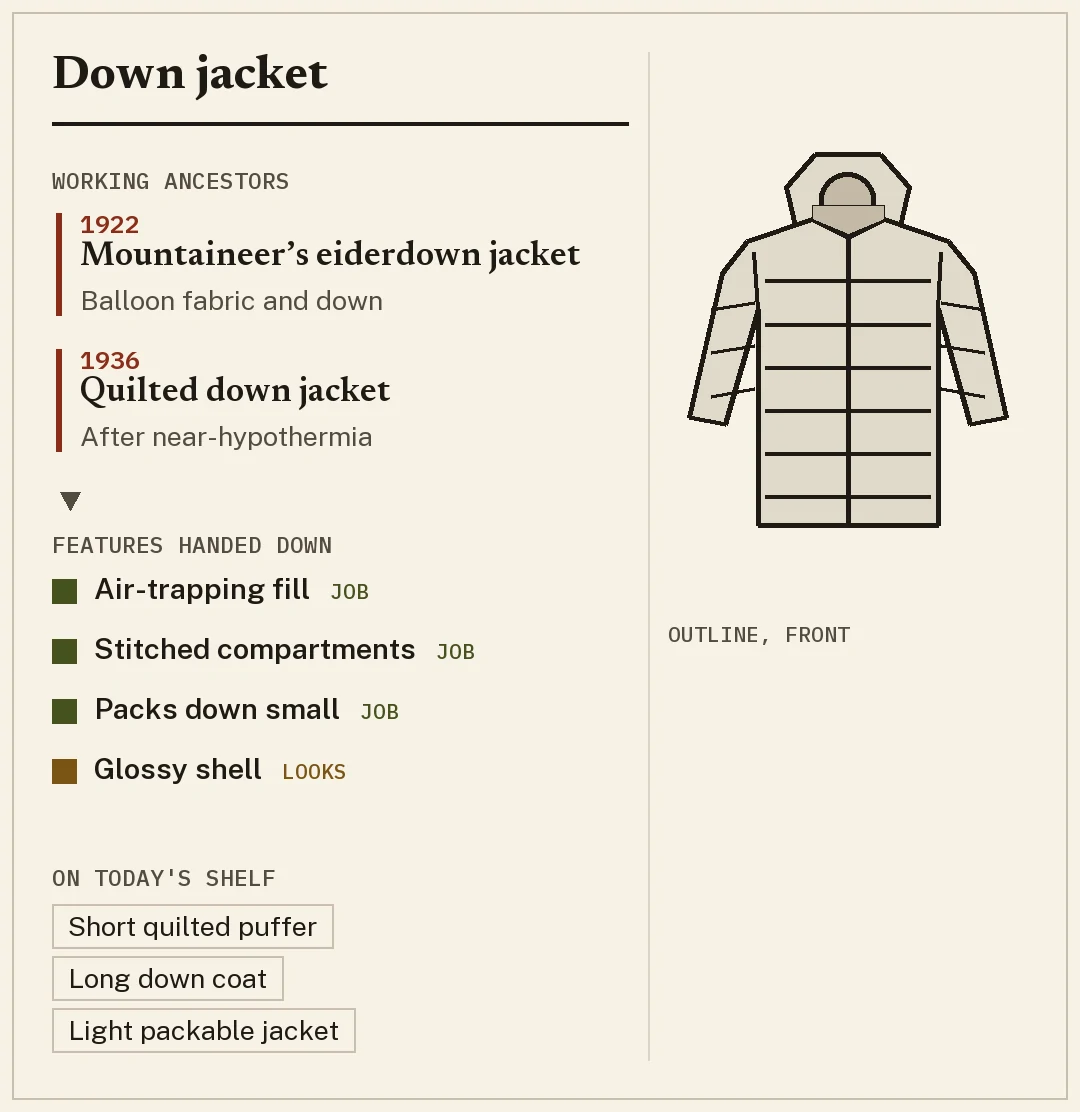
Down clothing has a mountaineering start. The encyclopedia entry on the down jacket credits a mountaineer with first wearing a version of the down jacket in 1922, made from balloon fabric and eiderdown, and describes a quilted down jacket made in 1936 by an outdoorsman who had nearly died of hypothermia on a winter fishing trip; he patented the design in 1939.
The same entry explains why the jacket works: the bulk of the feathers creates air pockets that hold warm air. Down compresses into a small space and gives the best warmth for its weight, which is why hikers and backpackers favor it. The stitched compartments are what hold that fill spread across the body; the entry on down feathers adds that down insulates best when dry.
The puffer later became evening wear in the 1940s, an athleisure jacket in the 1970s and a club and street staple in the 1990s. Through all of it, the working core stayed the same: fill, compartments, a hood. On the catalog, those are still the parts doing the work; the sheen of the shell and the size of the compartments are mostly about the look.
The fishtail parka and its folding tail
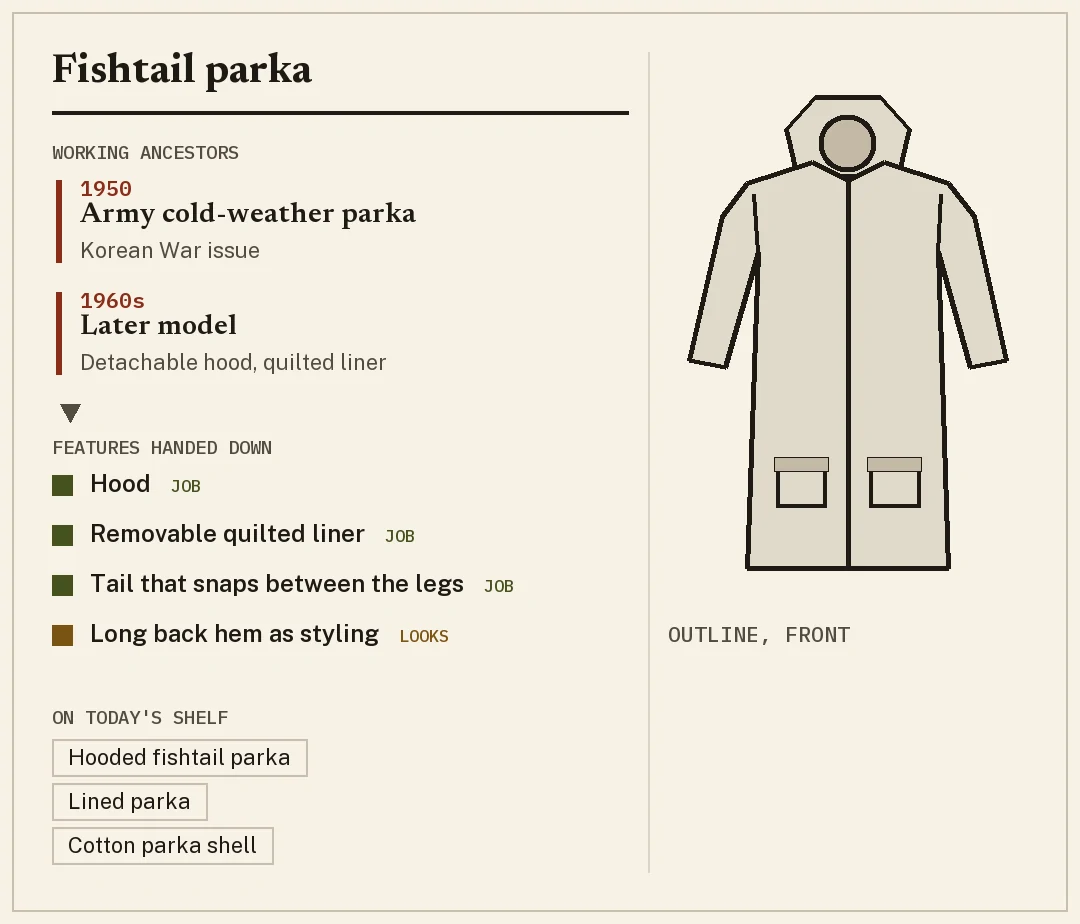
Armies needed their own parka. The encyclopedia entry on the parka says the fishtail parka was first used by the United States Army in 1950 during the Korean War, part of a post-war cold-weather system that ran through several models, each named for the year it was standardized.
The name comes from the tail at the back. It could be folded up between the legs and fixed with snaps for extra windproofing, or folded away at the back for freedom of movement. A later model added a detachable hood and a removable quilted liner. The civilian versions of the 1970s and 1980s came in many colors, most with an orange quilted lining.
On a catalog fishtail parka, the long back hem is usually there for the silhouette, because few wearers snap a tail between their legs. The hood and the removable liner, where present, still work. Ask about the liner if the listing does not show the inside: it is the difference between a winter coat and a long rain shell.
Windbreakers and fleece against wind chill
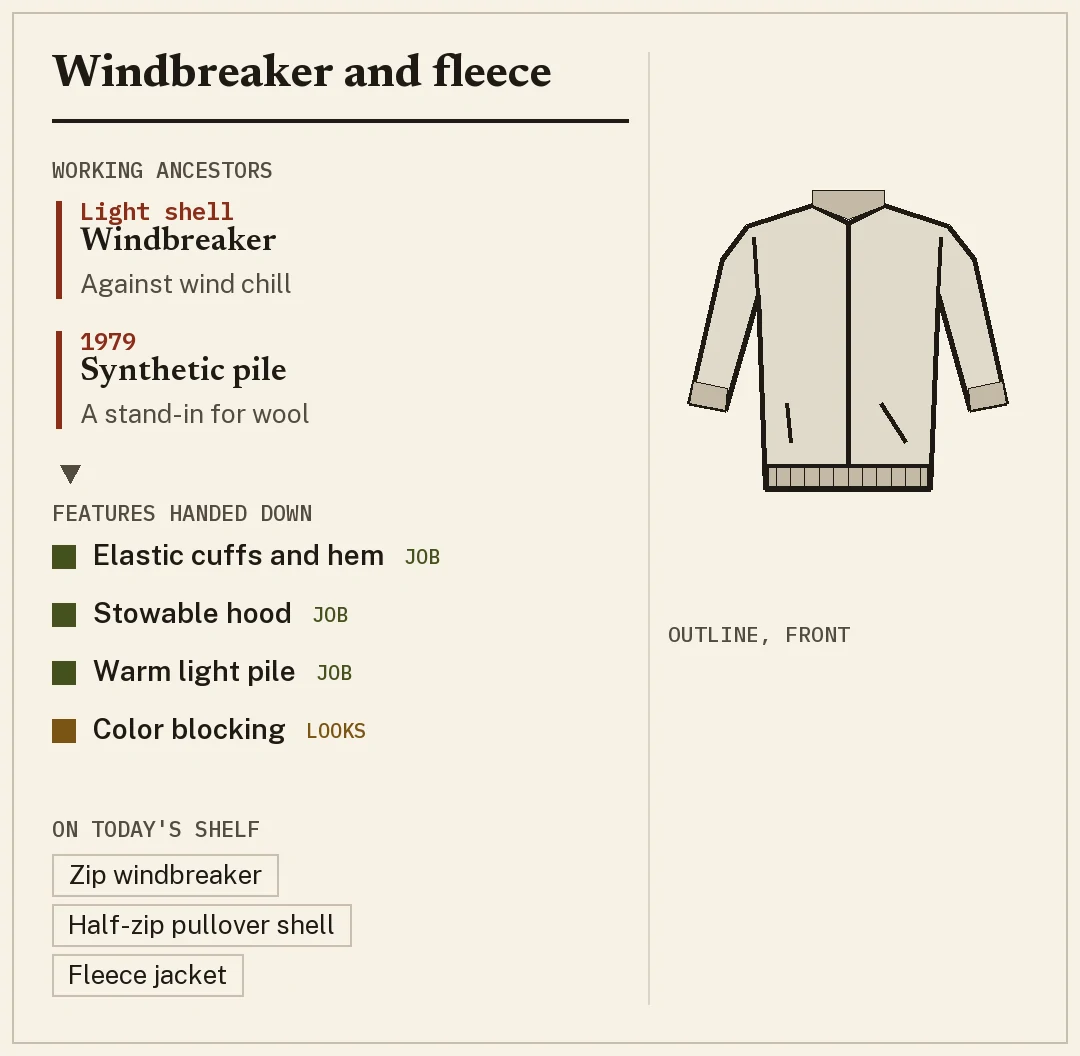
The windbreaker is the outdoor family’s light member. The encyclopedia entry on the windbreaker defines it as a thin jacket designed to resist wind chill and light rain, usually synthetic, often with an elastic waistband, elastic armbands and a zip so the wearer can adjust it to the weather. Many have a hood that is removable or stows away, and large pockets that keep belongings dry.
Fleece arrived as a substitute for wool. The encyclopedia entry on polar fleece says it was developed in Massachusetts in 1979 as a light, strong pile fabric meant to mimic wool, and in some ways surpass it. The fleece jacket and the windbreaker work as a pair, one holding warmth and one stopping wind, which is how many people still wear them.
On the catalog, elastic cuffs, a drawcord hem and a stowable hood are the inherited features that still do the job. A windbreaker’s bright color blocking and a fleece jacket’s contrast panels are styling. Neither the windbreaker nor fleece makes a promise about rain beyond light showers.
Knit hats for long watches outside
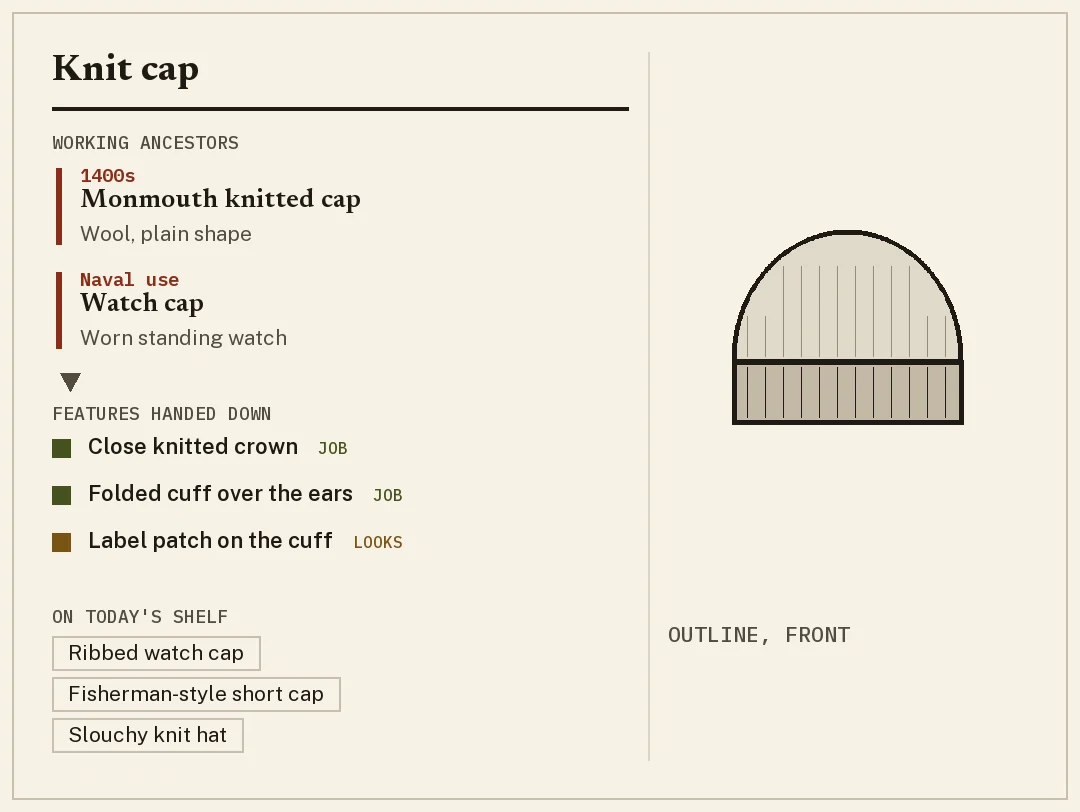
The knit cap is the oldest item on this page that you can still buy almost unchanged. The encyclopedia entry on the knit cap dates the earliest knitted wool cap type to the fifteenth century, produced in the Welsh town of Monmouth, and describes the knit cap simply as headwear designed to provide warmth in cold weather, usually with a plain tapered shape.
It goes by local names: a beanie or watch cap in American English, a toque in Canadian English. Members of the United States military call it a watch cap because it is the headgear worn while standing watch on a ship or at a guard post.
Almost everything about a knit cap still does its job. The close fit holds heat; the folded brim doubles the knit over the ears. The patch or label stitched to the cuff is the exception, and on the hat shelf it is where most marks sit.
Checking an outdoor find in the warehouse photos
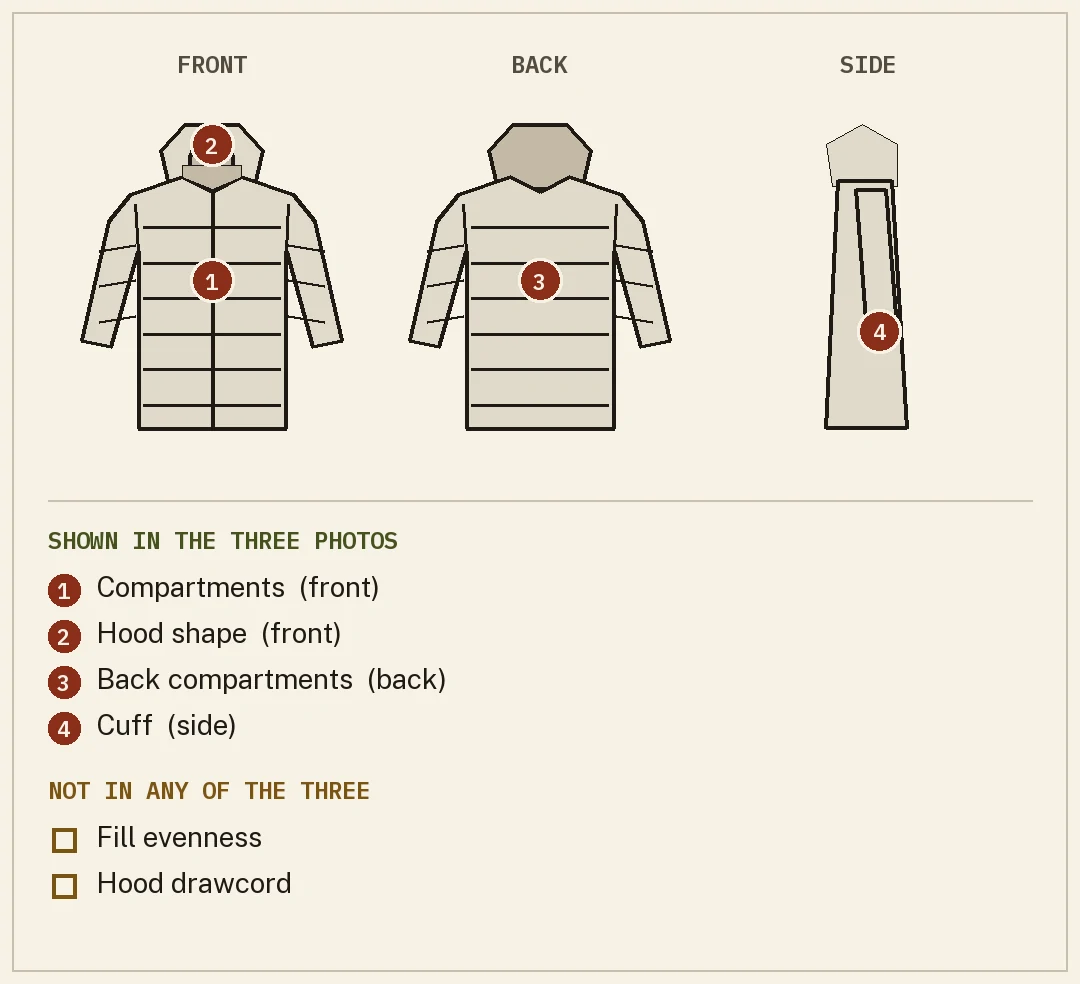
Outdoor garments are the hardest family to judge from three photos, because their working features are about what is inside. A front photo of a puffer shows the compartments and the hood. It does not show whether the fill is even across each compartment, whether the hood has a drawcord, or whether a parka’s liner is still in the coat.
Fatobuy’s regular photos are usually a trio: front view, rear view, and a side or logo close-up. For a parka, ask for the inside with the zip open; for a windbreaker, ask for the collar unzipped if a stowed hood is part of the appeal. Those two requests answer more about an outdoor coat than any number of front shots.
If you keep coats in the warehouse while you collect other finds, remember that storage is free only for a limited time, set out on our Fatobuy page. A bulky coat is also the item most likely to push a parcel into a higher freight band.