Military issue: what flight jackets, field jackets and cargo trousers were made to do
A good share of the catalog went into service before it went into shops. These sections follow each garment from its specification to the shelf, and mark which details still work. Independent reading; Fatobuy does not run or review this site.
Leather flying jackets of the open cockpit
Before cabins were heated, flying was cold work. The encyclopedia entry on flight jackets recalls an altitude record in April 1921, set at 40,000 feet in an open cockpit, and describes fur and later wool-lined shearling jackets as the warmest flight jackets of the period.
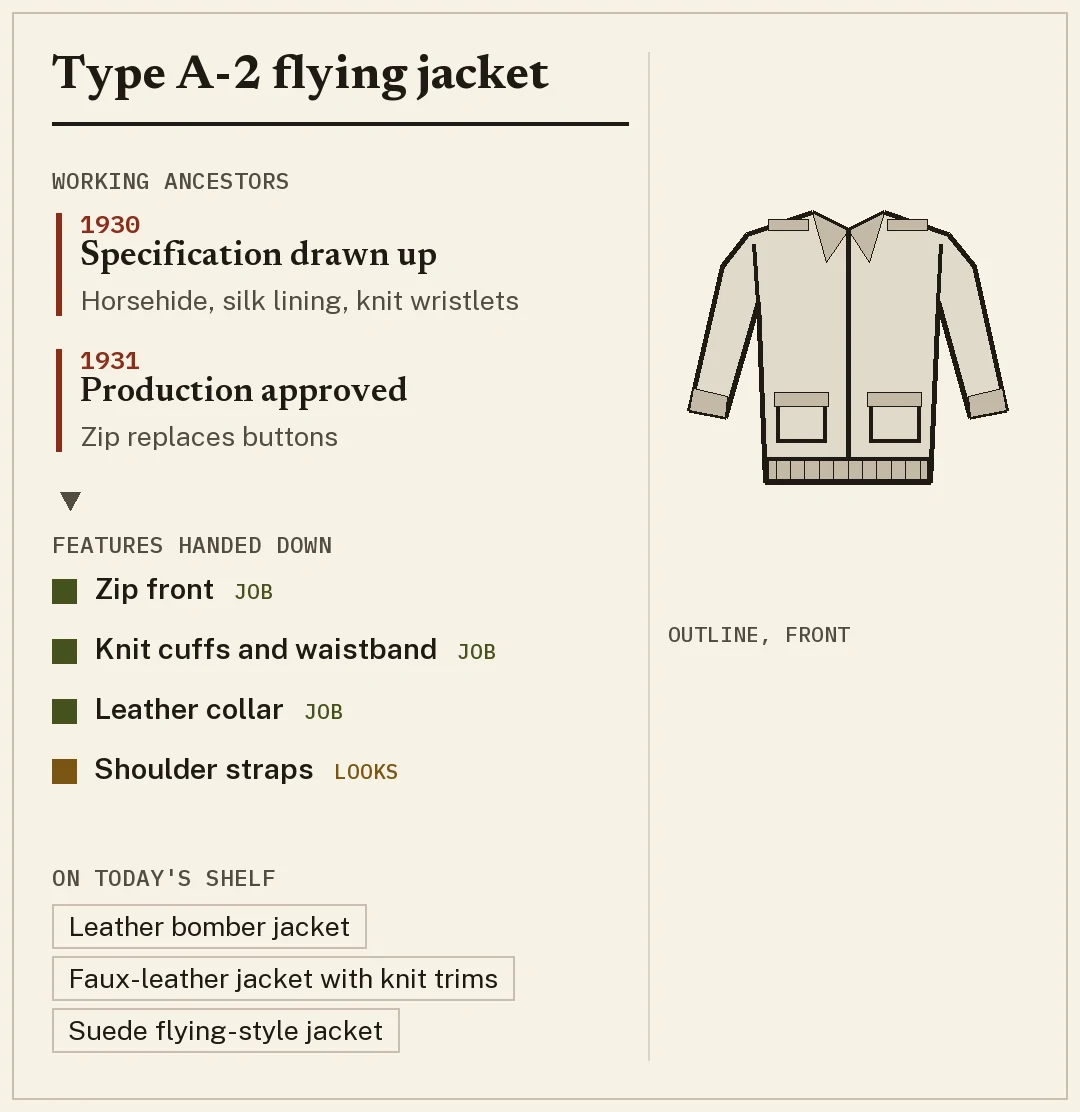
The leather jacket most catalog bombers descend from is the Type A-2. A history in Air and Space Forces Magazine quotes its 1930 specification: horsehide leather, a spun silk lining, a full leather collar, interlocking fasteners instead of buttons and knitted wool wristlets. Production was approved on 9 May 1931. The National Air and Space Museum catalog record adds that the 1931 order replaced the front buttons with a zip and that the jacket became associated with American pilots on every front of the Second World War.
Those specification lines map neatly onto today’s shelf. The zip and the knit cuffs and waistband were there to keep cold air out of a moving aircraft, and they still keep wind out of a jacket on a bicycle. The leather is now often something else, which changes how the jacket wears but not what the knit trims do.
Flight jackets and the bright lining inside
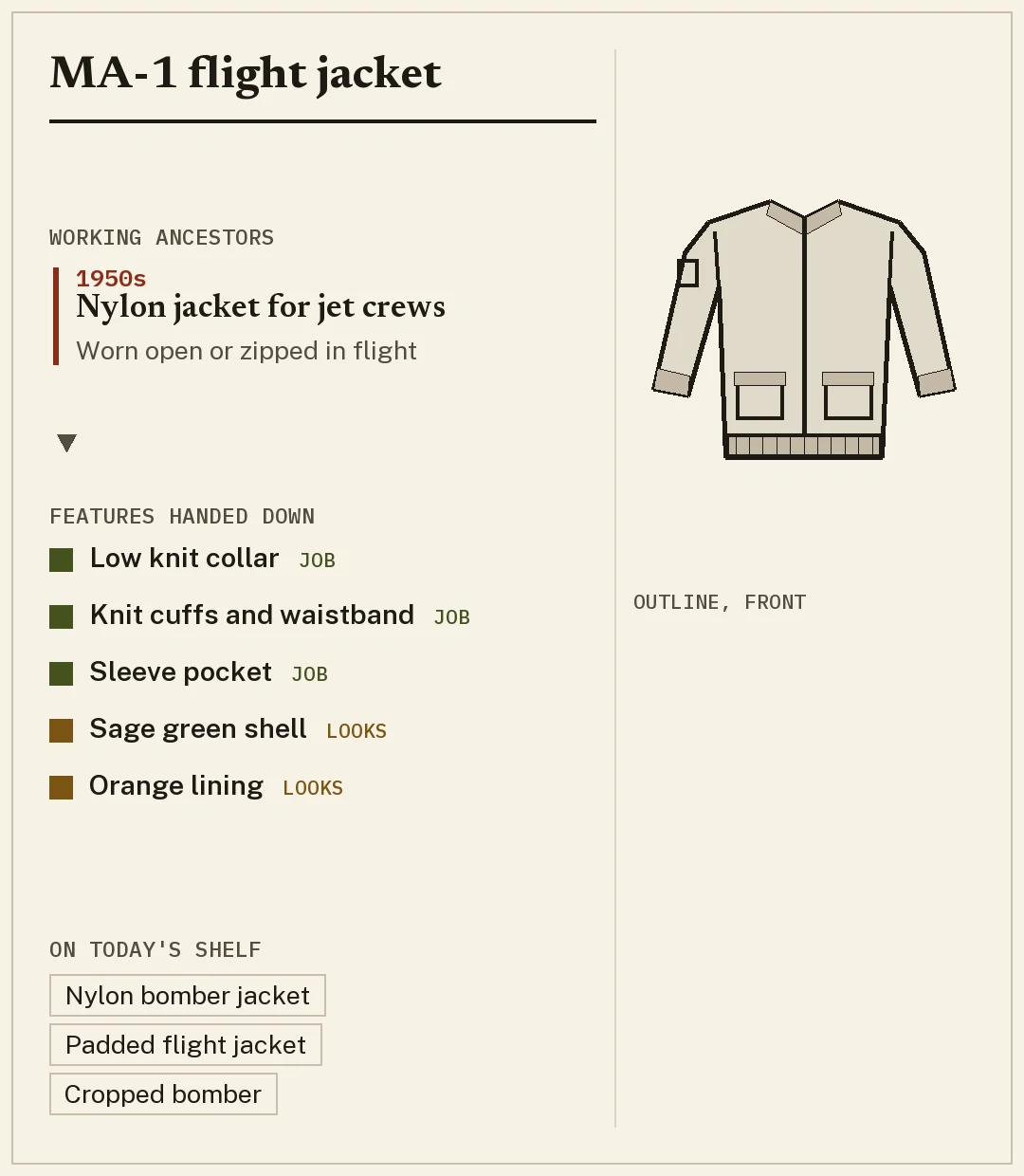
Jet aircraft changed the jacket again. The encyclopedia entry on the MA-1 jacket describes it as a year-round, intermediate-weight flight jacket designed for the United States Air Force, made of nylon with a polyester interlining: light enough to wear open in warm weather, warm enough once zipped inside the aircraft. Its predecessor had a wool pile collar that was found to interfere with straps, which is the commonly given reason for the low knit collar.
The color was a working choice too. The same entry says sage green was adopted because it blended into the surroundings if a pilot needed to hide on the ground. The orange lining is where the story gets thinner. The encyclopedia entry on flight jackets says the orange lining was there to aid visibility in case of an incident, and that explanation is repeated everywhere, but we did not find it in a military document, so this site treats it as the commonly told reason rather than a recorded one.
On a catalog shelf, the knit collar, cuffs and waistband still do their work, and the zipped sleeve pocket, which the same entry says carried pen holders, still holds a pen. The lining is a different matter: whatever it once did, on a city jacket it is a color you see when the zip is open. Mark it as kept for looks unless the listing shows the jacket worn inside out.
The field jacket that keeps a hood in its collar
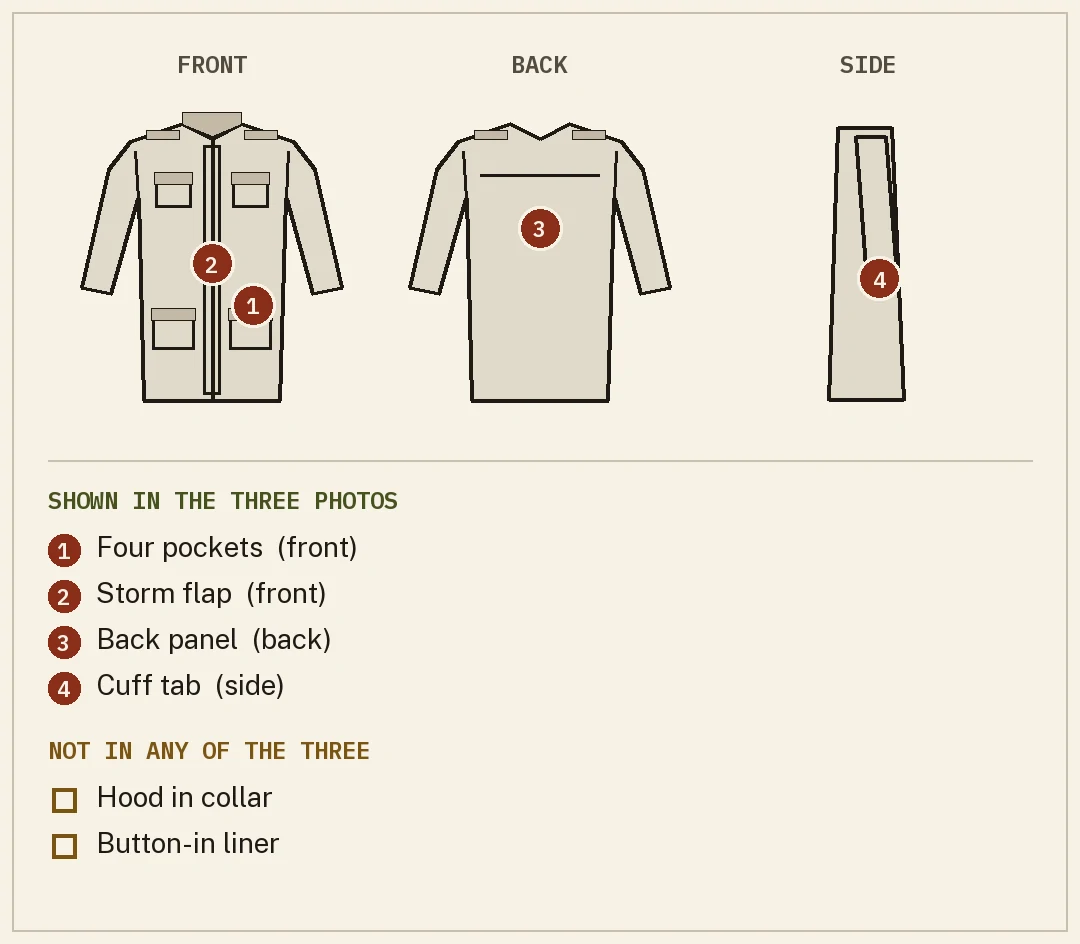
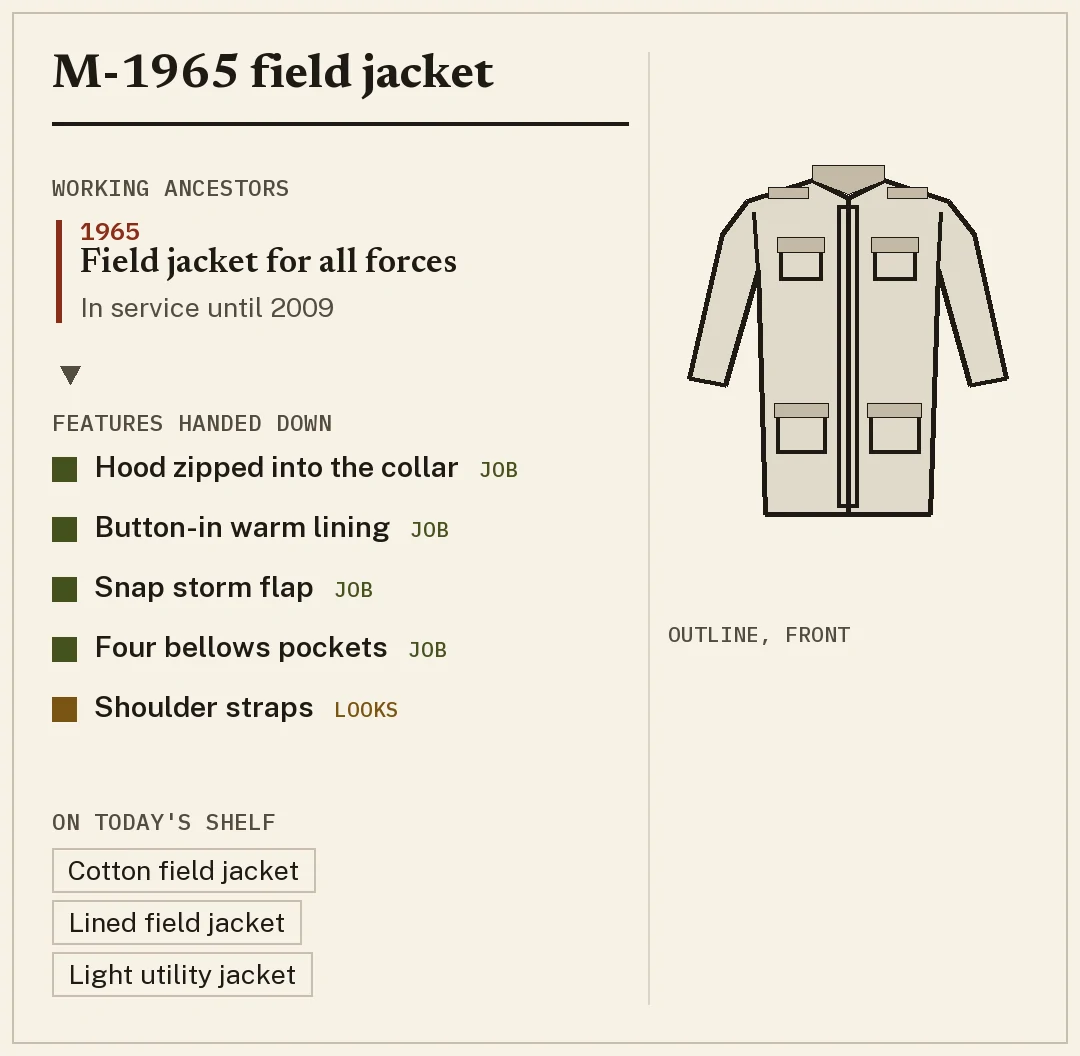
The M-1965 field jacket served the US armed forces from 1965 to 2009, according to the encyclopedia entry on the M-1965 field jacket. Its design is a list of answers to field problems. Two large hip pockets and two chest pockets carried gear. A zip in the collar housed a thin hood. A button-in insulated lining turned it into a cold-weather coat, and a storm flap closed with snaps covered the main zip.
The entry adds that the jacket was one of the first mainstream garments to use hook-and-loop fastening, on the cuffs and collar, and that the cloth was a tightly woven cotton blend that was windproof because of the weave and water-resistant with treatment. Late versions removed the shoulder straps.
That last detail is a useful test for catalog field jackets. Shoulder straps on a field jacket today are there for the military outline, since the issue jacket itself dropped them. The hood in the collar is the opposite case: it still works, but it is invisible in most photos, so a listing that promises one should show the collar unzipped.
Cargo trousers and the pocket on the thigh
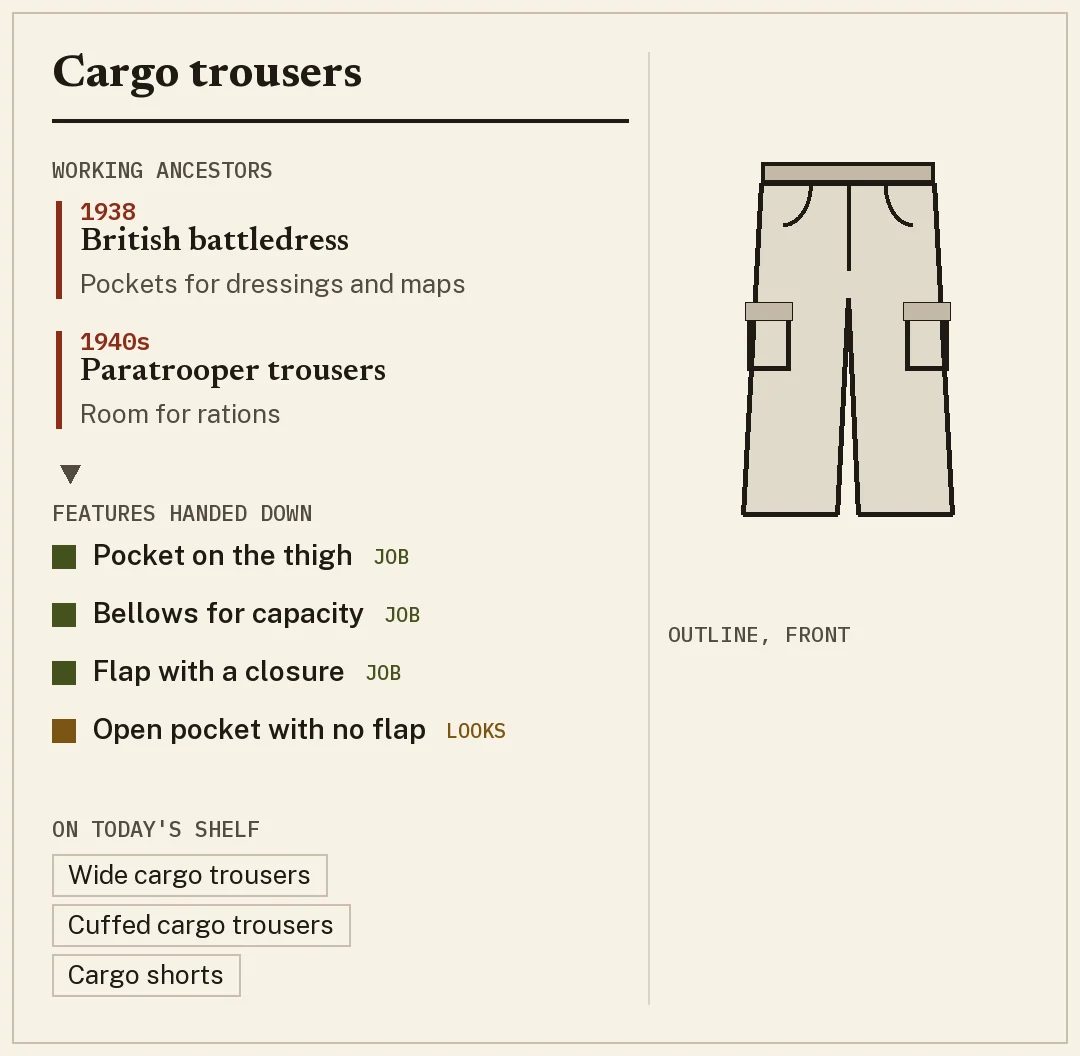
The big pocket on the side of the leg has a clear starting point. The encyclopedia entry on cargo pants says battledress was first worn by British forces in 1938, and that its large pockets were designed to hold field dressings, maps and other items. The idea was copied for US paratroopers, who used the extra room for rations and ammunition.
The same entry describes the cargo pocket itself: a patch pocket, often bellowed to increase capacity, closed with a flap held by a button, snap, hook-and-loop strip or magnet. Each of those details answers a problem. The bellows make room, the flap keeps the load from falling out when you run or kneel, and the thigh position puts the pocket where your hand already rests.
On a cargo trousers shelf, the flap is the feature to look for. A cargo pocket without a closure holds less securely than the soldier’s version and is closer to a decoration. This site describes the garment, not a use for it: cargo trousers here are everyday clothing, and nothing on this page is advice about kit.
The trench coat: straps, rings and buckled cuffs
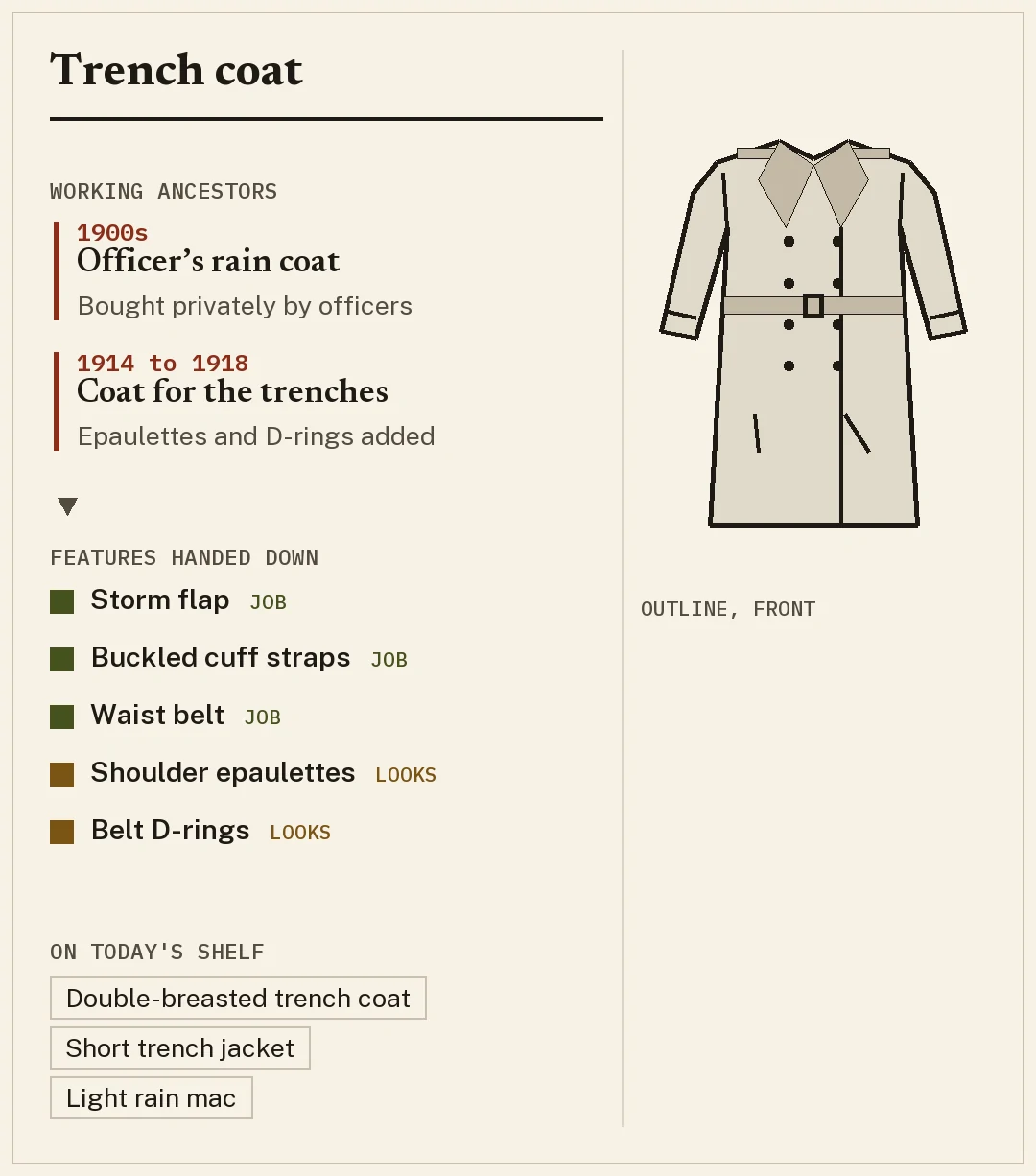
The trench coat was developed for British Army officers before the First World War and took its name from the trenches where it became common, says the encyclopedia entry on the trench coat. It was an officer’s coat in a strict sense: officers bought it privately, and other ranks were not permitted to wear it. The Imperial War Museums centenary page describes it as equipment bought by officers for protection against the conditions in the trenches of northern France and Belgium.
Its details have recorded reasons. The National Army Museum notes that shoulder epaulettes let an officer display his rank. The encyclopedia entry says the D-rings on the belt were for map cases, swords and other equipment, and calls the idea that they held hand grenades a popular myth. The buckled straps at the cuffs closed the sleeve so rain would not run down the forearm when an officer raised binoculars.
Read against today’s shelf, the storm flap, the belt and the cuff straps still do their jobs in rain. The epaulettes and D-rings do not: nobody clips a map case to a city coat, and rank is not worn on the shoulder. They stay because without them the coat would not read as a trench coat.
From navy undershirt to tee
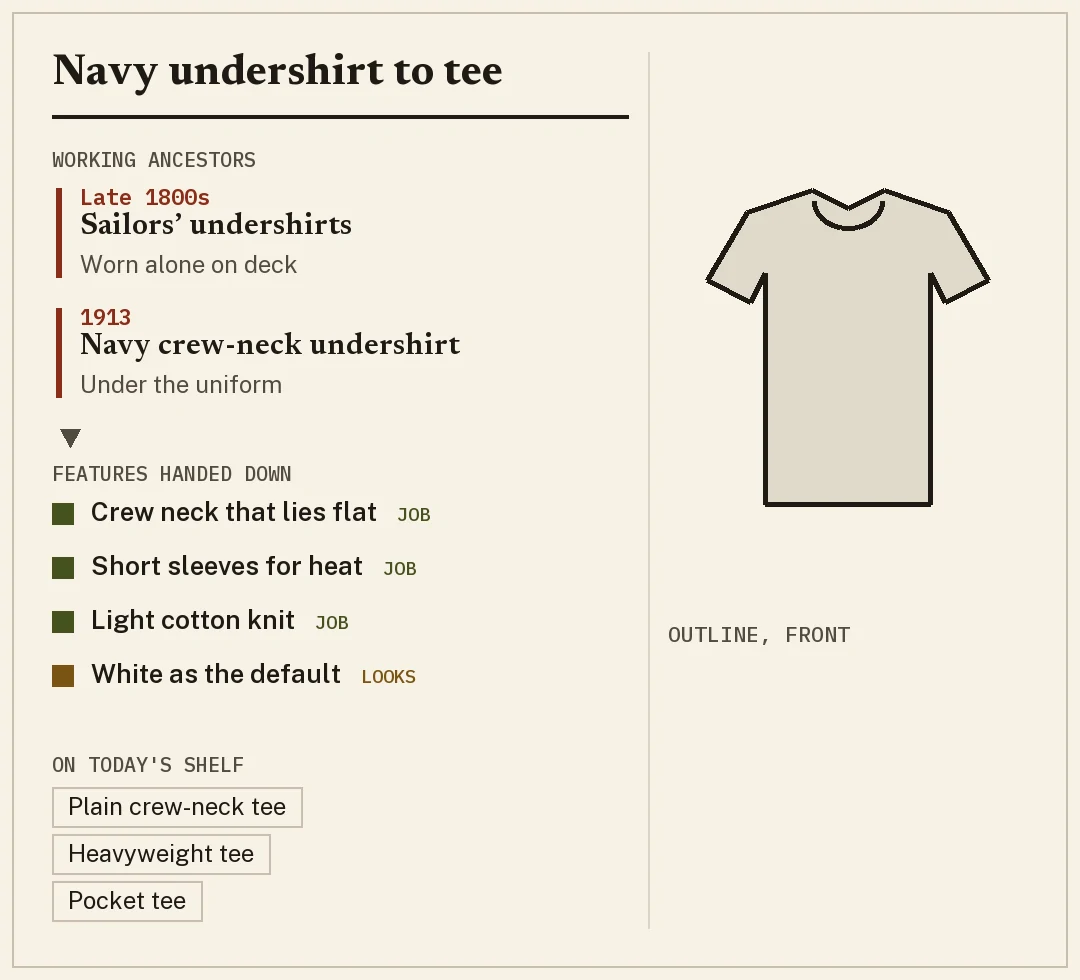
The tee’s military record is short and specific. The encyclopedia entry on the T-shirt says the US Navy first issued it in 1913 as a crew-necked, short-sleeved white cotton undershirt worn under the uniform. Sailors and Marines on work parties, in the early submarines and in tropical climates took off the uniform jacket and worked in the undershirt alone. After the Second World War, veterans wore it with uniform trousers as casual clothing.
The Victoria and Albert Museum’s blog puts the British Navy into the story as well: in the late nineteenth century its sailors wore a sleeveless heavy wool undershirt and were allowed to work on deck in it, while the American uniform of the early 1880s showed a white undershirt at the neck of a pullover jersey.
So the features that still work on a tee are the ones the navy specified: a crew neck that lies flat under another layer and short sleeves for heat. White as the default is the part that is now a choice. If you buy tees for layering, the neckline is the detail to check in the front photo.
Pea coats and watch caps from the deck
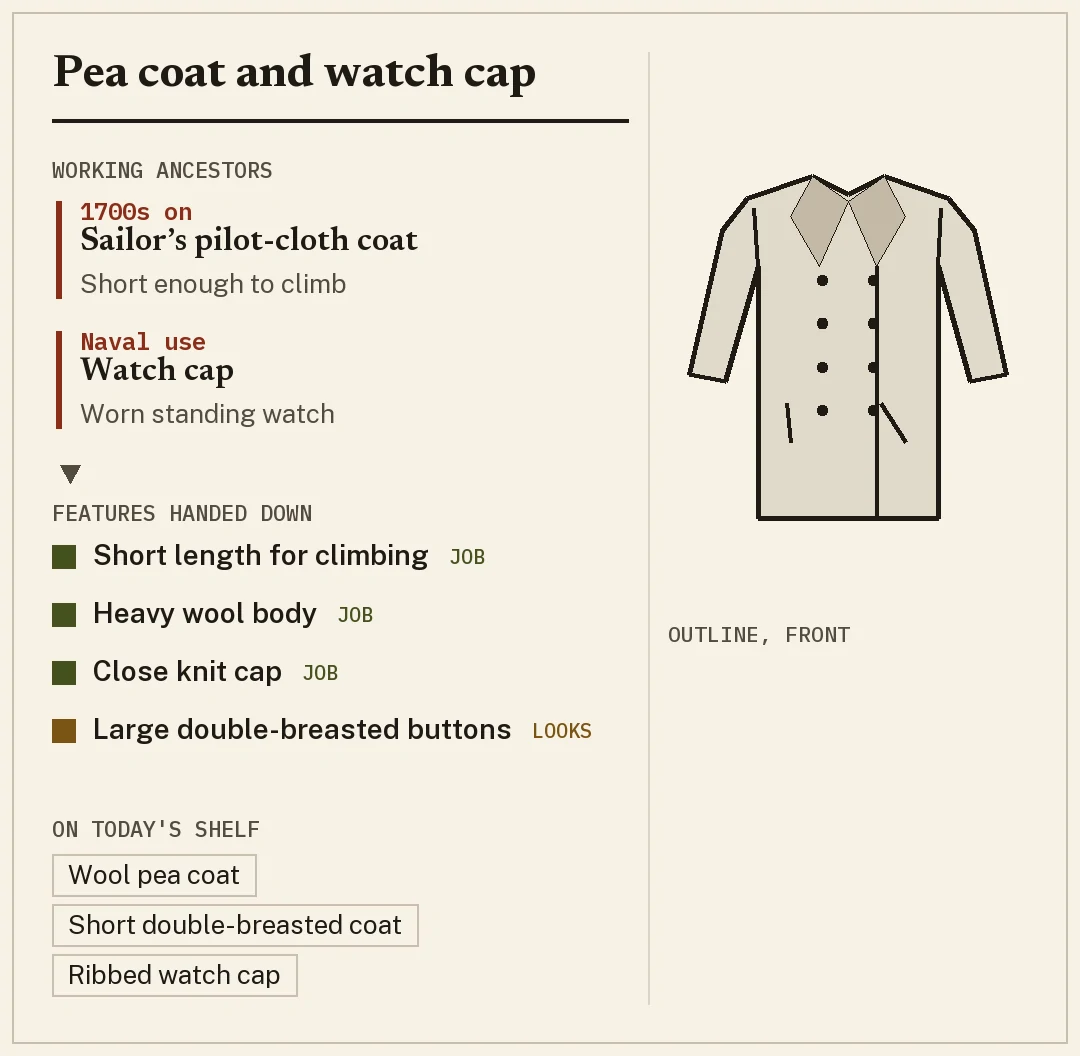
Two cold-weather pieces came off ships. The encyclopedia entry on the pea coat describes a short, heavy wool coat with broad lapels and a double-breasted front, worn first by sailors of European navies and later the American one. Its name has two explanations: a Dutch word for the coarse cloth it was made from, or, in the version the US Navy favors, pilot cloth, shortened to P-cloth and then pea.
The same entry gives a telling detail about length. The bridge coat, an officer’s version that reaches the thighs, gave more protection to an officer who did not need the agility to climb the rigging. In other words, the ordinary pea coat was short because sailors had to climb. The encyclopedia entry on the knit cap adds the watch cap: what US service members call the knitted cap worn while standing watch on a ship or at a guard post.
Both still do their main job. A short heavy coat keeps the body warm and leaves the legs free; a knit cap keeps heat in. The double row of large buttons is the part most often kept for the look, since a single zip would close the coat as well.
Spec codes and army wording on a listing
Military names travel well on a catalog. A listing may call a jacket an MA-1 or an M-65, or simply say army or military. Those are specification names and style words; they describe a cut, not a history. A catalog jacket called MA-1 may or may not have a reversible lining, and one called M-65 may or may not have a hood in its collar. The photos decide, not the title.
This is also where Fatobuy’s standard photos are most likely to miss the point. The hood stowed in a collar, the lining color, the inside pockets and the second cargo pocket on the far leg all hide from a front, back and side set. If one of them is why you want the garment, ask for a detail photo of that one thing before the parcel ships.
One more caution. This site reads military garments as everyday clothing. It does not recommend any piece for field, security or survival use, and a listing that claims a garment is real service issue is making a claim the photos cannot settle.