
Field notes
Fatobuy Spreadsheet: the detailed reading room
The original specialist explanations and interactive tools, collected in one place. Start with the buying guide for the full order journey.
Family tree viewer: pick a shelf, trace its ancestors
How to use the tool: choose one of the eight shelves. The viewer lays that shelf out on three branches: the working garments it descends from, each tagged with a decade (a label, not a calculated date); the features those garments handed down; and the forms you meet on the catalog today. Every feature carries one of two marks, still does a job or kept for looks. Open a feature for the reason and the public record behind it. Nothing you choose is saved or sent anywhere; the viewer runs in your browser only.
Clothes that started as equipment
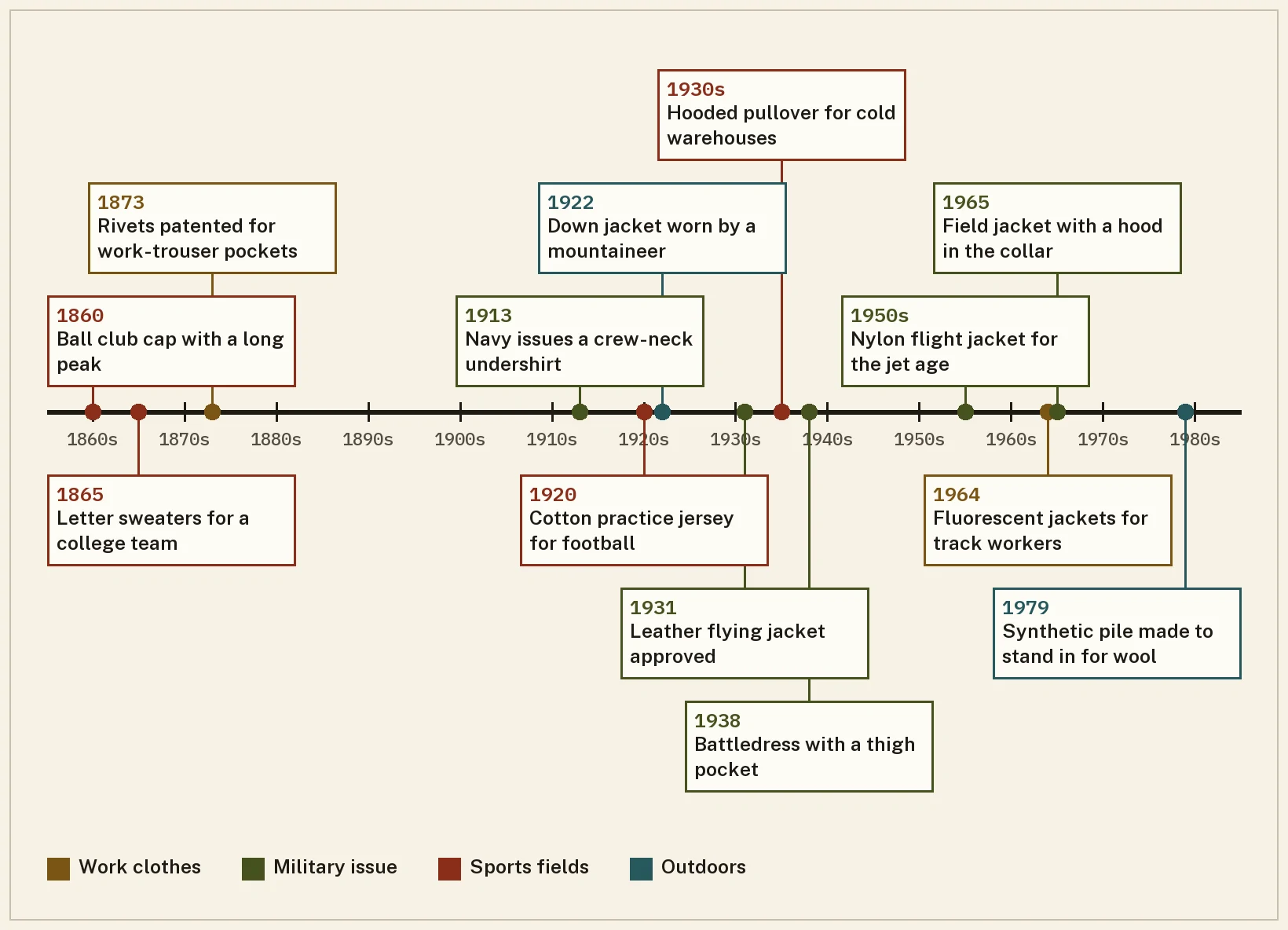
Walk along any finds catalog and you are looking at a museum of old jobs. The hooded sweatshirt began, by the usual account, as a 1930s pullover for people working in cold New York warehouses; the encyclopedia entry on the hoodie traces the hood itself back to medieval cowls. The tee was a navy undershirt before it was a shirt. Jeans were trousers for miners and farm hands, and the rivets on their pockets were patented in 1873 for one reason: seams kept tearing. The cargo pocket on the thigh was cut for soldiers who needed somewhere to keep a field dressing and a map.
None of that makes a catalog find better or worse. What it gives you is a question to ask of every listing: the ancestor did a particular job, so which of its features still do that job here, and which ones only stayed because people liked the look? The timeline below shows the dates this site leans on. Each one is linked to its public record on the family pages, and where a story is only commonly told rather than documented, we say so.
Four families on the catalog
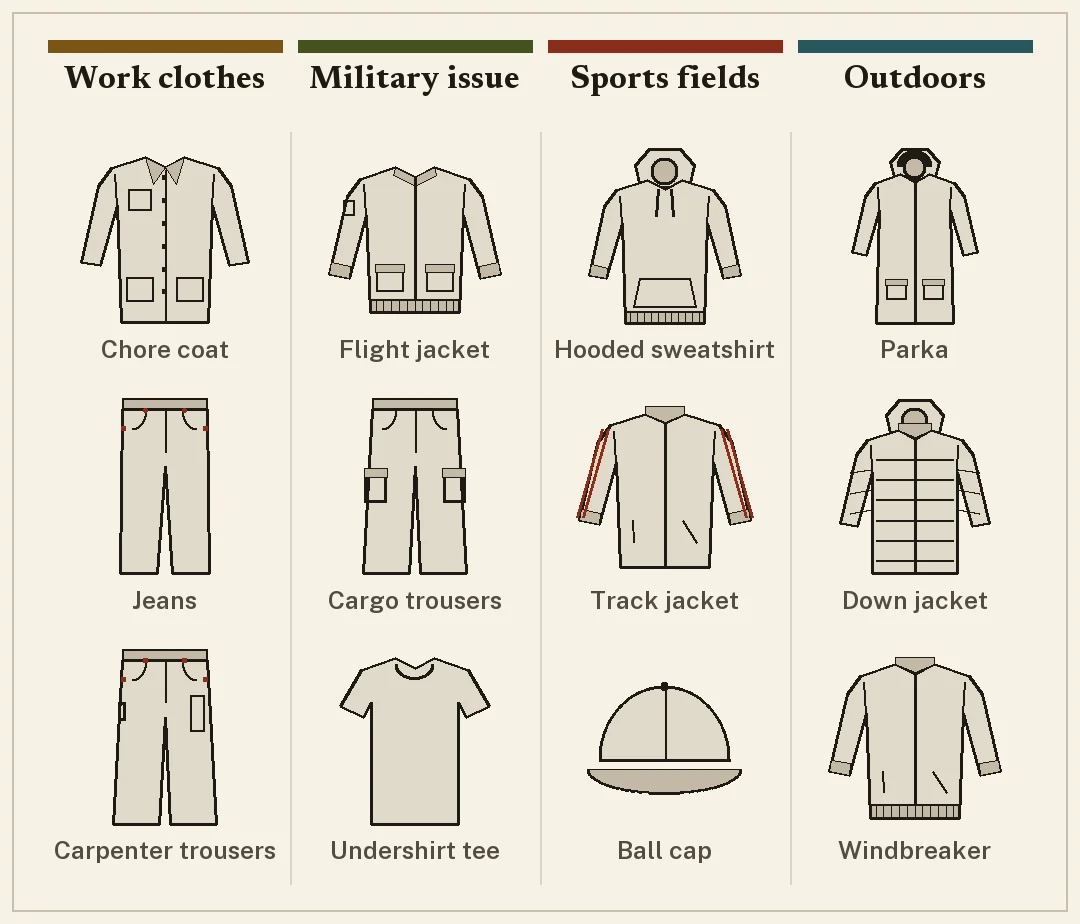
Every shelf on this site is filed under one of four working families. Work clothes covers the chore coat, jeans, overalls and carpenter trousers: clothing for wear, weather and tools. Military issue covers garments that went into service first, such as flight jackets, field jackets, cargo trousers, the trench coat and the navy undershirt that became the tee.
Sports fields gathers what athletes wore before and after the game: the cotton practice jersey, the hooded sweatshirt, the warm-up suit, letter jackets and the ball cap. Outdoors takes the cold-weather side: Arctic parkas and anoraks, down jackets, windbreakers, fleece and knit hats.
Some garments sit between families. The hooded pullover served warehouse workers first and athletes later; the knit watch cap belongs to sailors and to anyone standing outside in winter. Where that happens, the family pages say which job shaped which feature, so the reasoning does not depend on the label we chose.
What the Fatobuy Spreadsheet is, and why it reads by ancestry
A Fatobuy Spreadsheet, as people use the phrase, is a catalog of finds: shelves of product cards grouped by category, every card leading to a live listing that an agent such as Fatobuy can purchase for you. It is a place to discover things, not a shop. Prices, stock and sizes live on the seller’s listing and can change by the hour.
What we do differently is the reading. Most catalogs tell you what a garment is called; this one tells you what it was for. A field jacket entry here comes with the job of the 1965 jacket it descends from and a short note on which of its parts still work. We do not rank finds, score them or name any label, and nothing here is paid placement.
Picking a spreadsheet site is mostly a question of maintenance. Ask whether its links still answer, whether it dates its claims, and whether it tells you who writes it. We recheck every outbound link before each update and drop dead links instead of leaving them up. The last full pass is dated in the footer.
Fatobuy in brief
Fatobuy places orders with Chinese sellers for people abroad. Your goods land at its Jinjiang warehouse in Fujian, get photographed, and leave together in a single international parcel when you give the word. You pay in two parts. The first covers the item and the seller’s freight to the warehouse; the second covers international freight and a per-parcel clearance charge once you submit the parcel.
Orders from the main marketplaces carry no service fee, according to its help center, while a few kinds of source are charged. The free check usually comes with three basic photos. The full breakdown of fees, photos, storage, shipping and after-sales rules is on our Fatobuy page, each line dated.
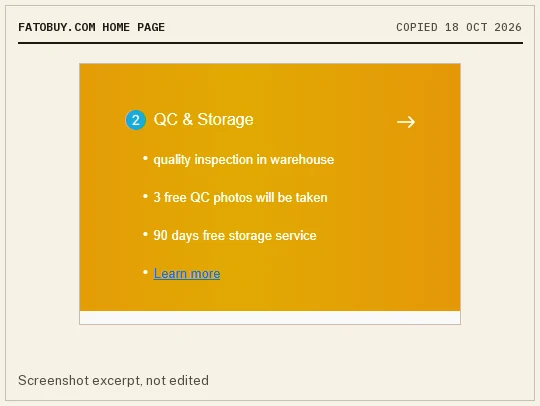
This site is independent. Fatobuy does not run it, has not reviewed it and does not pay for it. The panel beside this text is copied from the agent’s home page so you can see its own wording.
From a catalog card to your door, step by step
The steps are the same for any find on any shelf. Pick a card, read its family notes here if you want them, and open the listing. Copy the listing’s link, paste it into Fatobuy, choose the color and the option you want on the seller’s page, and pay the first part.
The seller ships to Jinjiang. When the piece arrives, Fatobuy logs it as in stock and posts its photos to your account. This is the moment the family tree reading earns its keep: you already know which inherited parts matter on this garment, so you can see at once whether the photos show them.
If a part you care about is out of frame, ask for a detail photo before you ship. When everything you want is in the warehouse, submit the parcel, pay the freight and the clearance charge, and pick a shipping line. The reading a find page goes through each step with an example garment.
Where the free photos stop showing the inheritance
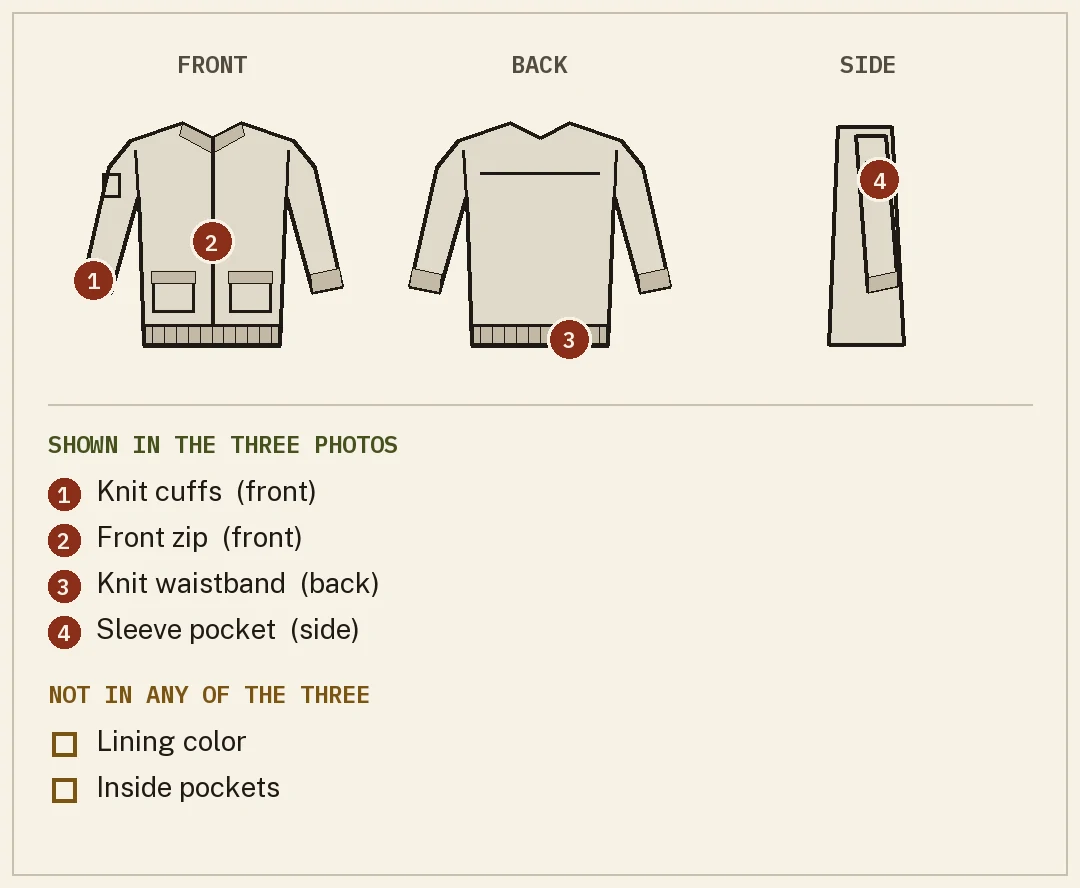
Fatobuy’s help center puts the regular inspection photos at generally three, covering the garment’s face and rear plus a side or the logo. That is a sensible set for checking that the right item arrived in one piece. It is a poor set for checking inherited features, because so many of them hide.
The orange lining of a flight jacket is inside. The second cargo pocket is on the far leg. The drawcord channel of a hood folds behind the neck, and the hood stowed in a field jacket’s collar is zipped away out of sight. None of these turn up reliably in a front, back and side set, so if one of them is the reason you want the garment, it is the thing to ask about.
The reading a find page lists, garment by garment, which ancestral features the standard photos usually catch and which ones need a detail shot.
Features that still work and features that only stayed
Across the four families, the same split keeps turning up. Some inherited features still do the job they were invented for: a hood still keeps wind off your neck, knit cuffs still close the gap at the wrist, rivets still take the strain at a pocket corner. Others survived because they looked right. Shoulder straps once held an officer’s rank badges; most trench coats on a catalog shelf carry them for the line they draw.
The marks on this site are not scores. A feature kept for looks is not a defect, and a working feature is not a reason to buy. They are there so you know what you are paying for when a listing makes a fuss about a detail.
The working features ledger gives each feature its reason and its source, grouped by what the feature does: closing gaps, carrying things, resisting wear, or signaling something to other people.